Are There Lockers At Shibuya Sky?
The honest answer on lockers at Shibuya Sky, the real locker banks at Shibuya Station, prices, size limits, duration rules, and staffed luggage storage points near Shibuya.

Are There Lockers At Shibuya Sky?
Shibuya Sky itself publishes no locker tariff that this site's research could verify, so no locker price or locker count for the deck can be stated honestly. What is verifiable sits below it: Tokyo Metro alone publishes 146 locker doors at Shibuya Station, and Radical Storage lists seven staffed points in the Shibuya area, the nearest about 306 m from the station. A visitor with a suitcase plans around those, not around the deck.
The distinction matters more than it first appears. Search results for this question are dominated by pages that describe a locker facility at the attraction without naming an operator, a price, or a size limit, and an unverifiable claim about where your passport and suitcase will sit is worse than no claim at all. The honest position is simple: nothing in the verified research record for this site supports a statement about lockers inside Shibuya Sky, and a bag policy at an observation deck can change without notice.
What a reader can actually plan on is the layer cake of storage around Shibuya Station, which is one of the best-documented locker sites in Tokyo. Tokyo Metro's own station page lists its coin lockers at Shibuya: 146 doors at the Shibuya Station coin locker page. The Toei and JR East sides of the complex add more banks, on separate tariffs and separate duration rules, and those rules are where most travellers get caught out rather than at the deck upstairs.
The other thing worth saying early: no operator lists an attended baggage room at Shibuya. No operator, from Tokyu and Seibu to Tokyo Metro and JR East Logistics, lists an attended baggage room at Shibuya, and none of them shows a staffed left-luggage counter at Shibuya. That is a list omission rather than an explicit denial, but it is consistent across every source, and it means the realistic choices at Shibuya are coin lockers or a staffed network point.
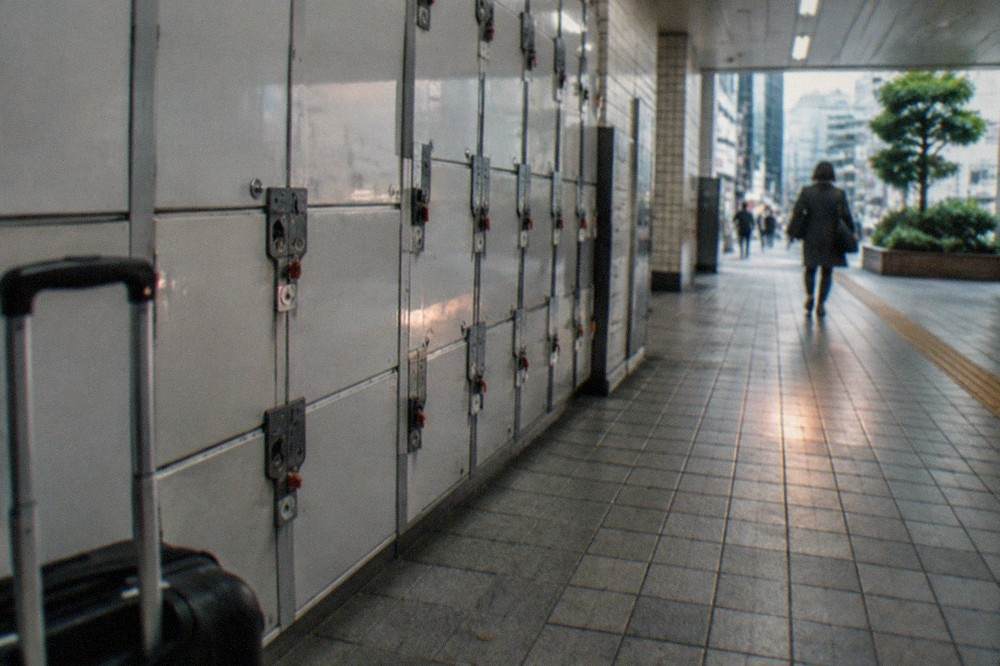
For a reader landing here mid-planning, the practical shape of a Shibuya Sky visit is this: arrive at the station, park the bag in a locker or at a staffed point, then go up. The deck is a timed-entry attraction, and a suitcase that cannot come inside a venue is the single most common reason a Tokyo visitor needs storage in the first place. Venue bag rules across the city, from Tokyo Skytree's 60 cm side limit to teamLab's 50 cm rule, push exactly this kind of bag into storage, and Shibuya is no exception to the pattern.
Where Are The Lockers Around Shibuya Station?
Tokyo Metro publishes 146 locker doors at Shibuya Station, spread across its banks inside the fare-paid area and concourse. Toei and JR East operate further banks on their own tariffs, and JR East's reservation service covers its Multi Ecube units for a 500 yen per-box surcharge. No operator publishes a combined all-operator locker count for Shibuya, and this site does not compute one.
That last sentence is worth pausing on, because the locker counts a traveller meets online are usually wrong in a specific way. English-language coverage of Tokyo lockers repeatedly reports a count of locker locations as a count of individual lockers. The 146 figure for Shibuya counts doors, stated by the operator itself, which is why it can be printed here. When a blog says a station "has 50 lockers", it is often counting 50 banks, each holding a dozen doors.
| Operator at Shibuya | What is published | Notes |
|---|---|---|
| Tokyo Metro | 146 doors | Official station page count |
| JR East Smart Logistics (Multi Ecube) | Network-wide figures only: 267 stations, 848 units | No station-level door count published for Shibuya |
| Toei Subway | Locker banks listed; no Shibuya yen figure published | Toei publishes no walk-up locker prices anywhere reachable |
| Attended baggage room | None listed by any operator | Consistent omission across four operator facility lists |
The reservation services are the part most visitors never hear about. JR East's Multi Ecube units can be reserved in advance through the operator's own live availability site for a 500 yen per-box surcharge, which is worth knowing on a weekend when the large banks empty out early. Tokyo Metro runs its own availability service, Locker Concierge, which is linked from Metro Commerce's own site header; it is a first-party Metro service, not a third-party app, a distinction that matters when a traveller is deciding which app to trust with a suitcase full of belongings.
For the station's other approaches, the picture thins out. Toei publishes no walk-up locker price in yen anywhere its site can be reached, so no Toei price can honestly appear on this page. The general shape of Shibuya storage, and of Tokyo station storage generally, is covered in more depth in the guide to Tokyo coin locker sizes and what fits, which carries the internal dimensions for each tier.
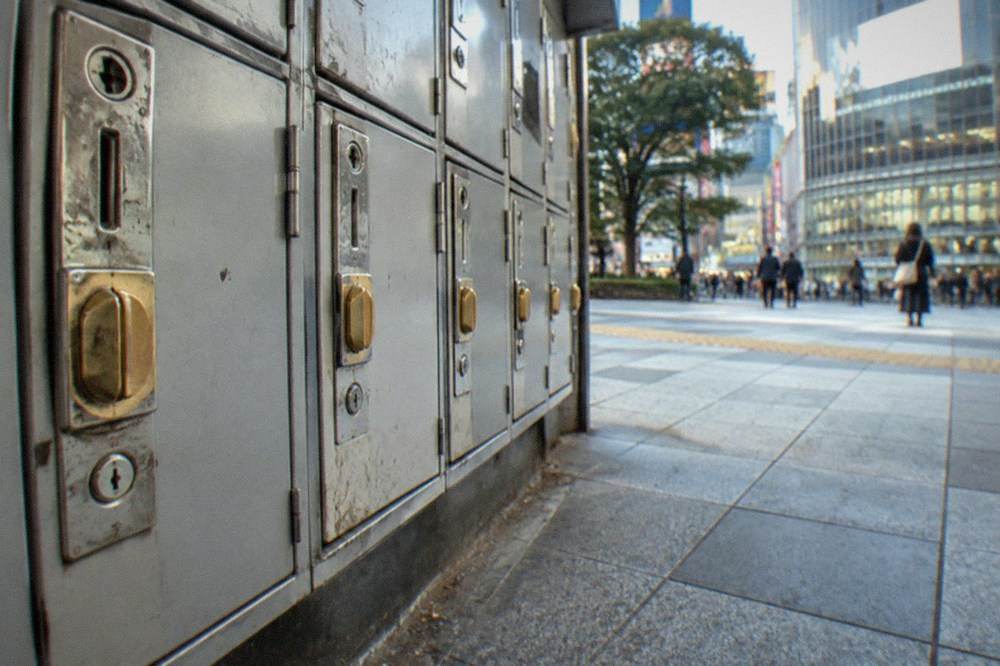
Placement inside the station is the practical question once the counts are settled. Tokyo Metro's lockers at Shibuya sit in the fare-paid areas and concourse, which means a visitor who has not yet touched a ticket gate should plan an extra few minutes to enter, store, and exit again. The IC card point matters here too: Suica and PASMO, the two transit cards nearly every visitor carries, are accepted at JR East locker banks, and at Tokyo Metro the accepted payment methods are whatever is displayed on the locker body itself, because Metro Commerce's terms deliberately decline to enumerate them.
How Much Do Shibuya Coin Lockers Cost?
Tokyo Metro charges 300, 500, 600, 900 and 1,000 yen per day, the same price ladder at every Metro station in the network, and only the mix of door sizes varies by station. JR East prices do vary by station: medium lockers run from 500 to 900 yen and large from 700 to 1,100 yen, with a 100 to 200 yen peak-season surcharge on the bigger tiers.
The Metro sentence is the one that contradicts most English travel writing, which describes Tokyo locker pricing as station-dependent across the board. It is not. Metro Commerce publishes one ladder across all 141 station-line rows on a single page, the operator's own coin locker tariff page, and that page is the source for every Metro yen figure in this article. What changes from station to station is how many of each size door exist, which is a very different problem from price.
| Tier | Tokyo Metro (all stations) | JR East published range |
|---|---|---|
| Smallest tier | ¥300 | ¥300 to ¥400 |
| S | ¥500 | ¥400 to ¥500 |
| Medium / M | ¥600 | ¥500 to ¥900 |
| Large / L | ¥900 | ¥700 to ¥1,100 |
| Extra-large (LW, JR East only) | not offered | ¥800 to ¥1,000 |
| Advance reservation | not offered | +¥500 per box |
The LW tier deserves a line of its own, because English-language coverage of Tokyo lockers does not mention it. At 86 x 56 x 65 cm it is the only common tier deep enough to take a wide checked suitcase lying flat, 56 cm against the 34 cm depth of a standard bank. A traveller whose case is a wide hard-shell should be hunting LW doors, not just any "large" door, and the reservation surcharge buys certainty that one is held.
Size is where the disappointment usually happens, and the numbers explain why. A Toei standard locker is 325 x 342 x 663 mm, and a JR East S tier is 33 x 34 x 65 cm. The binding constraint on a hard-shell suitcase is the 34 cm depth, not the width or the height. A 26-inch spinner is typically around 30 cm deep with the wheels, so it clears the depth and then fails the height on the standard tiers. Measuring the case before leaving the hotel, against the tier table in the sizes guide linked above, saves the most common failed errand in Tokyo.
Against those figures, the staffed alternative has one published price. Radical Storage's rate at its Shibuya points, as across its whole Tokyo network, is 850 yen per bag per day for a regular bag plus a 355 yen per-bag fee charged once at checkout, so one bag for one day is 850 + 355 = 1,205 yen. That is dearer than a 600 or 900 yen locker door, and a locker genuinely wins on price for one day when the case fits. The honest comparison runs the other way too, which the section on staffed points covers below.
How Long Can A Bag Stay In A Shibuya Locker?
Tokyo Metro lockers may be used for four days including the day storage starts; JR East's Multi Ecube lockers are limited to three days, and paying more does not extend the period. The operators disagree with each other, so no single duration rule can be stated for Shibuya or for Tokyo as a whole.
The Metro figure comes straight from the operator's own terms, the Metro Commerce coin locker terms, dated 2024-11-20 in the document itself. Four days including the start date means a bag dropped Monday morning must be out by end of service Thursday, not Friday. JR East Smart Logistics sets three days for its Multi Ecube lockers and says so plainly: the money cannot extend the period, the bag comes out on the fourth day regardless.
Two mechanics inside those rules catch people who read only the headline. The first is the 2 a.m. day boundary. A Metro locker day runs from first train to last train, a day is added at 2 a.m., and the first and last days each count as a whole day however briefly the locker was used. A bag stored for an hour before the last train still burns a full day. The second is the one-open rule on a reserved Multi Ecube unit: once the door opens and the bag comes out, the rental is over, and a multi-day reservation is forfeited without refund. The only grace is a 15-minute reopen button on the unit itself. Other pages covering the same trip are gathered on Luggage Storage in Tokyo.
What happens after expiry is the part worth reading before it happens, because it is a slow-motion problem. The operator unlocks the locker, inspects the contents and moves them to a designated place. The contents are then held for 30 days counted from the original start date, and the same daily rate keeps running the whole time. Collection requires the receipt, photo ID and the same IC card used to pay, and the separate storage fee is cash only. The traveller's own travel costs to go and collect the bag are the traveller's. After 30 days the contents are deemed abandoned and the operator may dispose of them, and may bill for the cost of disposal. JR East disposes of food immediately, with no grace period at all.
None of this is a reason to avoid lockers. It is a reason to set the return date honestly at the moment the bag goes in, which is a two-second habit that removes the entire mechanism.
What If The Locker Is Full, Or The Bag Will Not Fit?
Shibuya has no attended baggage room listed by any operator, and a suitcase that fails the size tiers has no staffed station fallback there. The verifiable staffed option in the Shibuya area is Radical Storage, which lists seven points with a 4.75 rating from 163 reviews, the nearest about 306 m from the station, five of them locker-style and two staffed.
That rating and review count belong to Radical Storage and its network pages, not to this site, and it is stated with the pool attached because a bare 4.75 invites a reader to imagine a survey that does not exist. Seven points is a genuine cluster by the standards of this network's Tokyo footprint, and it exists precisely because Shibuya's locker banks run out on weekends and event days. The pressure is predictable: the large doors go first, then the mediums, and by mid-afternoon a visitor with a full-size case can be walking the concourse looking at banks of small doors that will not take it.
The cost arithmetic for a staffed point is fixed and worth printing in full. Radical Storage charges 850 yen per bag per day for a regular bag, plus a 355 yen per-bag fee charged once at checkout, which does not scale with the number of days. One bag for one day is therefore 850 + 355 = 1,205 yen, presented here as arithmetic on Radical Storage's own published figures rather than as a quoted checkout price. Radical Storage advertises "from 490 yen per day", but that is a small-bag rate found at 11 of the Tokyo points on file, not what a traveller with a normal suitcase pays, and this site does not present it as the price of luggage storage in Tokyo.
What the staffed points buy, beyond a door that fits, is a human and a network behind the receipt. Every storage point recommended on this site is a real Radical Storage partner location, and this site neither owns nor operates any of them. Radical Storage's Guarantee applies to bookings made through the network. It is not insurance, their own terms say so in clause 9.2.2, and payouts are capped at EUR 3,000 per claim under clause 9.4, a cap the terms state in euros and which this site does not convert. A coin locker's contractual cap, by comparison, is 30,000 yen, set by Metro Commerce, JR East Smart Logistics, Tokyu and Keio in near-identical wording.
Is A Staffed Point Or A Locker The Better Choice At Shibuya?
For one day with a bag that fits a tier, a locker is cheaper: 600 to 900 yen against 850 plus 355 for a staffed point. A staffed point wins when the case exceeds the tiers, when the large doors are gone, or when the bag needs to sit longer than a locker's three or four days, and a Radical Storage booking has no posted closing time to miss.
The honest comparison cuts both ways, and pretending otherwise is how storage pages lose a reader's trust. A locker is a metal box with a published price, a published size and a published cutoff, and for a day bag it is the cheapest legitimate option in Shibuya. Its weaknesses are equally published: a size ceiling that fails wide cases, an expiry mechanism that keeps charging after the door is cleared, and a 30,000 yen liability cap that coincides exactly with the ban on storing anything worth 30,000 yen or more, which means the terms never contemplate paying for a valuable, because a valuable was never allowed in.
The staffed points have their own weaknesses and they should be stated too. Radical Storage publishes no per-point opening hours that can be generalised, and 146 of the 249 Tokyo points on file are not open 24 hours, despite the template wording in many of the network's own area page titles. Hours are checked per point at booking, not assumed. There is no hourly tariff anywhere in the network: a few hours is billed as a full day, exactly as a locker day counts whole, and as JAL ABC's airport counters count by calendar day. Part-day pricing simply does not exist in this market, on either side.
| Factor | Coin locker at Shibuya | Staffed Radical Storage point |
|---|---|---|
| One day, regular bag | ¥600 to ¥1,000 per tier | 850 + 355 = ¥1,205 |
| Wide checked suitcase | Fails standard depth; LW tier rare | Accepted; no published dimension cap per point |
| Maximum stay | 3 days (Multi Ecube) or 4 days (Metro) | Per booking, per point; no network-wide figure published |
| Retrieval | One open ends a reserved Multi Ecube rental | During the point's opening hours |
| Liability cap | ¥30,000, contractual, per operator terms | Radical Storage Guarantee, capped at EUR 3,000 per claim, not insurance |
The neighbouring areas widen the choice when Shibuya itself is tight. Harajuku, one stop away on the Yamanote line, carries four Radical Storage points with a 4.93 rating from 38 reviews, and Harajuku Station also has its own locker banks for the smaller tiers. Ueno, a few stops north, has eight points at 4.87 from 285 reviews, plus 127 Tokyo Metro locker doors at the station and an attended JR East Logistics baggage room on the 3F concourse inside the Park Gate, 500 to 2,000 yen by size with a 30-day maximum. Ueno is, in fact, one of the few places in Tokyo where every option on this page exists within one station complex.
Timing the whole thing around a Shibuya Sky visit comes down to the deck's own entry system. Tickets are sold in timed slots, the evening slots sell out first, and a bag plan built around a slot needs the storage leg done before the queue, not during it. A visitor arriving from Narita or Haneda with luggage has a separate decision entirely, between storage and forwarding, and the comparison of takkyubin forwarding against storing a bag is laid out in the guide to luggage forwarding versus storage in Tokyo. Forwarding moves the problem to the destination hotel; storage solves it for the afternoon. They are not substitutes, and the Narita and Haneda routes each have their own cut-off times worth knowing before the day of the flight.
One closing practical note, because it is the failure mode this site's research keeps finding. Keep the paper ticket. The Multi Ecube terms say the IC card used to pay is required at retrieval, while the Multi Ecube FAQ says the printed ticket unlocks the door regardless of how payment was made, and both are current official JR East group pages that disagree with each other. The safe line is to keep the ticket and treat the IC card as backup. If both go missing, the operator's locker helpline runs 08:00 to 21:00 and the four-digit door number is the first thing it will ask for.
Common Questions About Lockers At Shibuya Sky
Are there lockers at Shibuya Sky?
No locker price, locker count or locker operator for Shibuya Sky itself could be verified in this site's research, so no claim about lockers on the deck is made here. What is verifiable sits below: Tokyo Metro publishes 146 locker doors at Shibuya Station, and Radical Storage lists seven staffed points in the Shibuya area, the nearest about 306 m from the station.
How much is a locker at Shibuya Station?
At Tokyo Metro's Shibuya banks the price ladder is 300, 500, 600, 900 and 1,000 yen per day, the same prices at every Metro station. JR East banks at Shibuya price the medium tier from 500 to 900 yen and the large from 700 to 1,100 yen, with a 100 to 200 yen peak-season surcharge on the bigger tiers.
Can I leave a large suitcase at Shibuya Station?
It depends on size and timing. The standard locker tiers are about 34 cm deep, which a wide hard-shell case fails, and the extra-deep LW tier on JR East banks is rare. Shibuya has no attended baggage room listed by any operator, so a case that will not fit a locker is better taken to a staffed Radical Storage point; the Shibuya area has seven, at 850 yen per bag per day plus the 355 yen checkout fee.
How long can I use a Shibuya coin locker?
Four days including the start day at Tokyo Metro lockers, three days at JR East's Multi Ecube units, and paying more does not extend either period. After expiry the operator empties the locker, holds the contents for 30 days with the daily rate still running, and collection needs the receipt, photo ID and the IC card used to pay, with the separate storage fee in cash only.
Is Shibuya luggage storage safe?
Coin locker operators cap their contractual liability at 30,000 yen, and the terms ban storing anything worth 30,000 yen or more, so a valuable was never an allowed item. Radical Storage bookings carry the Radical Storage Guarantee, which is not insurance and is capped at EUR 3,000 per claim under its terms. The full safety picture, including the consumer-law floor beneath both, is in the guide to whether luggage storage in Tokyo is safe.
Can I reserve a locker at Shibuya in advance?
At JR East's Multi Ecube units, yes, through the operator's own reservation site for a 500 yen per-box surcharge. Tokyo Metro's banks at Shibuya are walk-up, though the operator's Locker Concierge service shows live availability. Reservation does not change the three-day Multi Ecube limit, and one open still ends the rental.
A visitor heading up to the deck with empty hands has done the hard part. The lockers at Shibuya Station are plentiful by Tokyo standards but shallow by suitcase standards, the staffed points around the station take whatever the tiers refuse, and the choice between them is a straight trade of price against fit. Measure the case, check the deck's own entry rules before the day, and the bag question stops being the risky part of the visit.