Overnight And Long-Term Bag Storage In Tokyo: Every Limit, Price And Rule
A coin locker in Tokyo is a three-day or four-day product. A station baggage room is a thirty-day product. A Radical Storage point is billed per day, with no hourly tariff at all. This guide sets out what each option genuinely allows a bag to do overnight and beyond, what it costs, and what happens when a stay runs long.
Short answer
Radical Storage points in Tokyo cost 850 yen per bag per day plus a 355 yen once-per-bag checkout fee, so seven days for one bag is 5,950 plus 355 yen. Coin lockers cap at 3 days on JR East and 4 days on Tokyo Metro. Tokyo Station baggage rooms allow 30 days at 500 to 2,000 yen per day; Haneda allows 2 weeks.
How Many Days Can You Leave A Bag In Storage In Tokyo?
It depends on which of Tokyo's three storage systems holds the bag. Tokyo Metro coin lockers allow 4 days including the start day, JR East's Multi Ecube lockers allow 3 days and paying more does not extend that, and Tokyo Station's attended baggage rooms allow 30 days. Radical Storage points are billed per day, with no hourly tariff at all.
The first thing to understand is that the per-day model of a Radical Storage point behaves differently from every alternative in the city. There is no clock ticking on a single afternoon. A few hours is billed as a full day, an overnight is one day, and a week is seven days at the same rate. The regular-bag rate is 850 yen per bag per day at 244 of the 249 Tokyo points on file, and a 355 yen fee per bag is charged once at checkout, never per day. Radical Storage advertises "from 490 yen per day", but that is a small-bag rate published at 11 points only, not what a traveller with a normal suitcase pays.
Every storage point recommended on this site is a real Radical Storage partner location, and this site neither owns nor operates any of them. That matters more for a long stay than a short one, because a bag parked for two weeks sits in someone's business for two weeks, under the network's own terms rather than a station's. The Radical Storage Guarantee is not insurance, as the network's own terms state, and payouts are capped at EUR 3,000 per claim.
The alternatives have hard, published ceilings, and the ceilings are the reason this comparison exists. Coin lockers, station baggage rooms and airport counters are the official options to weigh for a long stay, and each is covered in full below. A reader deciding tonight which system to trust with a bag until Friday needs three numbers: the day rate, the once-per-bag fee, and the maximum number of days each system permits.
One planning note before the detail: the phrase "overnight" hides a billing subtlety. Dropping a bag at 6 p.m. and collecting it at 9 a.m. is one day at a Radical Storage point, but at a coin locker the day boundary is 2 a.m. on the Metro network, and a JR East Multi Ecube rental ends the moment you open the door. The mechanics of each system matter as much as the headline price.
What Does Overnight And Multi-Day Storage In Tokyo Cost?
At a Radical Storage point the arithmetic is fixed: 850 yen per bag per day, plus a 355 yen fee per bag charged once at checkout. One bag for one day is 850 plus 355, which is 1,205 yen. A week for one bag is 5,950 plus 355, and two weeks is 11,900 plus 355, always shown as arithmetic on the network's own published figures.
The once-per-bag fee is the number most comparison writing leaves out, and it does not scale with the number of days. That makes a long stay proportionally cheaper per day than a short one: the 355 yen is amortised across every night the bag sits. Quoting the day rate alone understates a one-day booking by roughly a third, which is why every price in this guide carries both numbers.
| Stay length, one regular bag | Day-rate arithmetic | Once-per-bag checkout fee | Total as arithmetic |
|---|---|---|---|
| 1 day | 850 yen | 355 yen | 850 + 355 = 1,205 yen |
| 3 days | 2,550 yen | 355 yen | 2,550 + 355 = 2,905 yen |
| 7 days | 5,950 yen | 355 yen | 5,950 + 355 = 6,305 yen |
| 14 days | 11,900 yen | 355 yen | 11,900 + 355 = 12,255 yen |
For contrast, the cheap end of the official system is a standard coin locker, but a locker large enough for a suitcase is not the cheap end at all. Tokyo Metro publishes one price ladder network-wide, 300 to 1,000 yen depending on tier, with the same prices at every Metro station. The large tier that swallows a suitcase sits at the top of that ladder, and JR East's large lockers run 700 to 1,100 yen depending on the station, with a peak-season surcharge of 100 to 200 yen on the bigger tiers. A full price breakdown across every option lives in the Tokyo luggage storage prices guide.
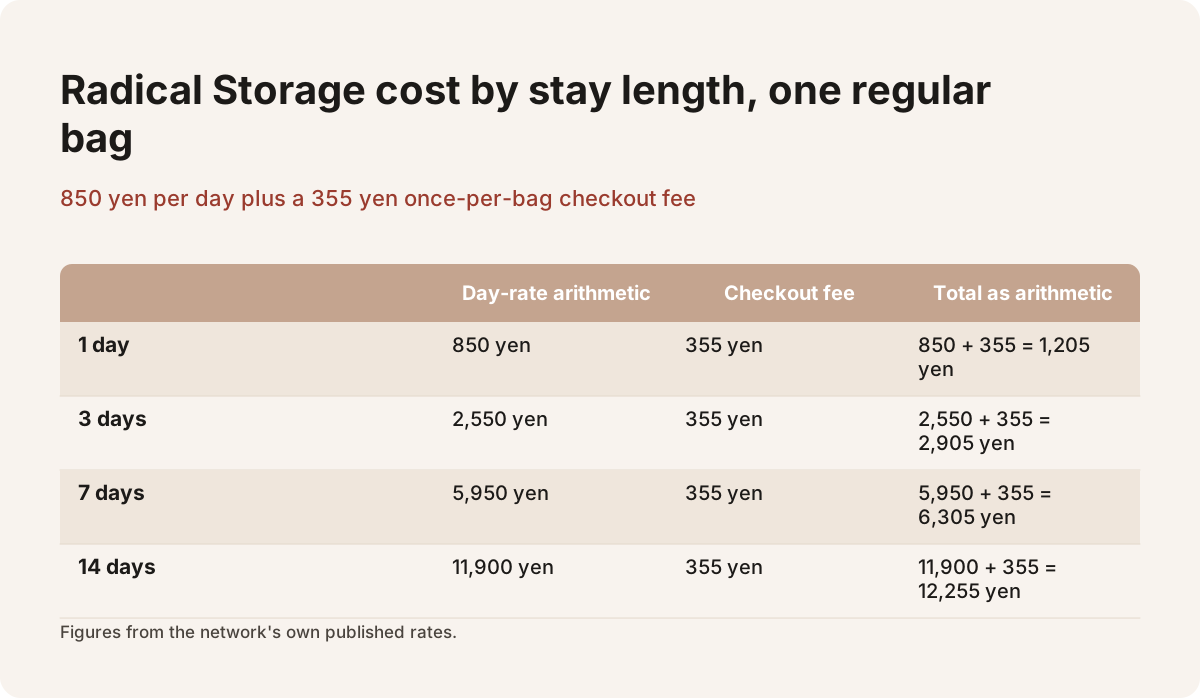
The practical reading of the chart is simple. For a single overnight, a station baggage room at 500 yen for a small bag or a Metro locker at 300 to 600 yen for a small-to-medium bag can undercut a Radical Storage point, and this guide says so plainly. For anything past a few days, the per-day model, the absence of a duration trap, and the ability to book the exact number of days ahead of time tip the balance, and the sections below show exactly where each alternative's ceiling bites.
Do Tokyo Stations Have Baggage Rooms For Multi-Day Storage?
Tokyo Station has several attended JR East Logistics baggage rooms at 500 to 2,000 yen per bag per day with a 30-day maximum, and Ueno has one inside the Park Gate on the same 30-day rule. Shinjuku, Shibuya and Ikebukuro have none of their own. Shinagawa's room sits inside the Central Gate, with weekday and weekend rates.
The attended baggage room is Tokyo's genuine long-stay product, and it is concentrated in one place. Tokyo Station alone carries the Yaesu South room outside the gates, the BAGGAGE STORAGE+ counter in Gransta B1, the Shinkansen South Transfer Gate counter and the Marunouchi Central counter, all run by JR East Logistics, all open roughly 09:30 to 20:00, all priced at 500 yen for a bag up to 100 cm, 1,000 yen up to 200 cm and 2,000 yen above that, and all allowing 30 days. The official operator page lists all of them: the JR East Logistics baggage service page.
Ueno's room sits on the 3F concourse inside the Park Gate, 10:00 to 20:00 daily, the same three price tiers, the same 30-day ceiling. Shinagawa's is different in two ways: the rates are M at 800 yen on weekdays and 1,000 yen on weekends, L at 1,600 and 2,000 yen, and the maximum period is not published. Those weekend rates are also forced onto weekdays during 27 April to 6 May, 10 to 19 August, and 28 December to 6 January.
| Attended baggage room | Hours | Price per bag per day | Maximum stay |
|---|---|---|---|
| Tokyo Station, Yaesu South | 09:30 to 20:00 | 500 / 1,000 / 2,000 yen by size | 30 days |
| Tokyo Station, Gransta B1 | 09:30 to 20:00 | 500 / 1,000 / 2,000 yen by size | 30 days |
| Tokyo Station, Shinkansen South gate | 09:00 to 21:00 | 500 / 1,000 / 2,000 yen by size | 30 days |
| Ueno Station, 3F inside Park Gate | 10:00 to 20:00 | 500 / 1,000 / 2,000 yen by size | 30 days |
| Shinagawa, Event Space YK | 10:00 to 19:00 | M 800 weekday / 1,000 weekend; L 1,600 / 2,000 | Not published |
| Shinjuku, Busta 3F (Sagawa) | 06:30 to 21:00 | 800 / 1,000 / 1,500 yen | Not published |
The absences are as useful as the presences. Shinjuku has no JR baggage room of its own: JR East's own material scopes its Travel Service Center luggage storage to Tokyo Station only, and no operator list places a room at Shinjuku, Shibuya or Ikebukuro. What Shinjuku does have is the densest Radical Storage cluster on this site's roster: 8 points, rated 4.75 from 384 reviews, with the nearest 187 m from the station, six of them staffed, two of them listed as open 24 hours and two locker-type points among them. For a bag that needs to sit near Shinjuku for several days rather than inside Tokyo Station, those points are the working option.
A baggage room needs a human at a desk, which is both its strength and its limit. The desk closes at a stated hour, payment is per bag per day with no once-per-bag booking fee, and nothing needs to be reserved in advance, but a room cannot be pre-booked the way a Radical Storage point can, and a desk that is full is full. The JR East Logistics rooms also close entirely on some holidays, and Shinagawa's closes 1 January. Anyone planning a stay that spans a Japanese public holiday should treat the opening hours as the deciding fact, not the day rate.
Can You Leave Luggage At A Tokyo Airport For A Week Or Two?
Yes. Haneda's own sitewide rule allows storage for up to 2 weeks, with Terminal 1 and 2 desks priced per day and the Terminal 3 desks, open 24 hours, priced per 24 hours at 800, 1,000 or 2,000 yen. Yamato's counter in Haneda Terminal 2 states no limit on the storage period. Narita's counters are attended and charge per piece per day from 500 yen.
The airport tier of the answer is documented on the operators' own pages, and the detail is in the clocks. Haneda Terminal 1 and Terminal 2 storage desks, both on B1F, run 08:00 to 19:30 and bill per day. Haneda Terminal 3, the international terminal, runs two desks open 24 hours, on 2F and 3F, and bills per 24 hours. Same three price numbers, different day boundary, which matters for a late-night departure. The full tariff is on the official Haneda baggage checkroom page, which also states the sitewide caps: three sides totalling no more than 300 cm, weight no more than 30 kg.
| Airport counter | Hours | Price per piece per day | Maximum stay |
|---|---|---|---|
| Haneda T1, B1F South | 08:00 to 19:30 | 800 / 1,000 / 2,000 yen | 2 weeks |
| Haneda T2, B1F North | 08:00 to 19:30 | 800 / 1,000 / 2,000 yen | 2 weeks |
| Haneda T3, 2F and 3F | Open 24 hours | 800 / 1,000 / 2,000 yen per 24h | 2 weeks |
| Haneda T2, Yamato 3F | To 22:45 handover | 800 / 1,000 / 2,000 yen | No limit stated |
| Narita T2, Promotion Foundation 3F | 06:30 to 22:00 | 500 / 700 / 1,100 yen | Not published |
| Narita, Sagawa counters | Varies by counter | 500 / 700 / 1,150 yen | Not published |
| Narita, JAL ABC counters | Varies by counter | 800 / 1,000 / 2,000 yen | Not published |
Two conflicts in that table are recorded rather than smoothed over. Yamato's own published sheet for its Haneda Terminal 2 international counter says "no limit on storage period", while Haneda's sitewide rule says 2 weeks; both are official, neither overrides the other, and the safe planning line is Haneda's 2 weeks. JAL ABC at Narita charges by calendar day, not by the hour, so a part-day is a full day, exactly like a Radical Storage point's no-hourly-tariff rule. The wider set of guides lives on Luggage Storage in Tokyo.
One boundary must be stated plainly: Radical Storage has no storage point inside any terminal at either airport. The nearest point to Narita is about 6.0 km away in Tomisato, Chiba, and the nearest to Haneda is about 3.4 km away in Kawasaki, Kanagawa, across a prefecture boundary. A bag cannot be dropped inside a terminal through this site; the airports' own counters above are the in-terminal option, and the airport-to-city delivery services, with their real cut-off times, are covered in the Narita to Tokyo with luggage guide.
What Are The Coin Locker Duration Traps Overnight?
Tokyo Metro lockers allow 4 days including the start day, the day rolls at 2 a.m. rather than midnight, and the first and last days each count as a whole day however briefly the locker was used. JR East Multi Ecube lockers allow 3 days, and paying more does not extend the period. Opening the door ends a Multi Ecube rental, with a 15-minute reopen grace.
The duration rules are the part of the locker system that the traveller never sees until it is too late, and they come from the operators' own terms. Metro Commerce, which runs the Metro lockers, states the 4-day period including the start day, and JR East Smart Logistics states 3 days for its Multi Ecube network, adding in plain words that on the fourth day the bag is pulled whether or not more money is inserted. The full terms are in the Metro Commerce coin locker terms.
| Operator | Maximum period | Day boundary | Price ladder |
|---|---|---|---|
| Tokyo Metro (Metro Commerce) | 4 days including the start day | 2 a.m. | 300 to 1,000 yen, same at every Metro station |
| JR East Multi Ecube | 3 days, not extendable by payment | 2 a.m. | 300 to 1,100 yen, varies by station |
| Narita airport lockers | 8 days | Midnight | 400 to 800 yen per day |
| Haneda T1 and T2 lockers | 7 days, then 30 days in storage | 24 hours | 400 to 1,500 yen per day |
| Haneda T3 lockers | 7 days, then 30 days in storage | Per 24 hours | 500 to 900 yen, XL 2,000 |
What happens after the period expires is worth knowing before, not after. The operator unlocks the locker, inspects the contents and moves them to a designated place. The contents are held for 30 days counted from the start date of the original rental, the same daily rate keeps running throughout that separate storage, and the travel costs of going to collect the bag belong to the traveller. Collection needs the receipt, photo ID and the same IC card used for payment, and the separate storage fee is cash only. JR East disposes of food immediately, with no 30-day grace. There is a fuller treatment of the day-counting rules in how long you can leave luggage in Tokyo.
Liability is the second quiet rule. All four major locker operators publish the same cap, 30,000 yen, as a contract term rather than a statutory one, and the same terms ban storing anything worth 30,000 yen or more, which is why the cap and the ban are the same number. A laptop was never an allowed item in a coin locker, and no locker will make an owner whole for one.
Is Luggage Forwarding Better Than A Long Storage Stay?
For a bag that would otherwise sit for a week or more, takuhaibin, luggage forwarding, often wins on price: a 160-band suitcase from Tokyo to a Tokyo address costs 2,410 yen, and to Kyoto or Osaka 3,160 yen, against 850 yen per day accumulating at a storage point. No carrier publishes transit times for personal customers, so no delivery time can be stated here.
The forwarding maths is the honest way to decide between storing and sending. Two weeks at a Radical Storage point is 11,900 plus 355 yen. Sending the same bag across the country on Yamato's TA-Q-BIN costs 3,160 yen in the 160 band, 4,480 yen in the 180 band, 5,410 yen in the 200 band. If the bag only needs to exist somewhere until a return flight, storage wins. If it needs to be at a destination, forwarding wins decisively from about day four onward, and the trade-offs are laid out in full in luggage forwarding versus storage in Tokyo.
| Yamato TA-Q-BIN band, Kanto origin | Tokyo to Tokyo | Tokyo to Kyoto or Osaka |
|---|---|---|
| 120 (up to 120 cm or 15 kg) | 1,730 yen | 2,170 yen |
| 140 (up to 140 cm or 20 kg) | 2,090 yen | 2,780 yen |
| 160 (up to 160 cm or 25 kg) | 2,410 yen | 3,160 yen |
| 180 (up to 180 cm or 30 kg) | 3,030 yen | 4,480 yen |
| 200 (up to 200 cm or 30 kg) | 3,690 yen | 5,410 yen |
The size caps decide which carrier can take the bag at all. Yamato's hard ceiling is 200 cm three-side total, 30 kg, no single side over 170 cm, and a suitcase is charged at its measured size. Sagawa's large-size service goes to 260 cm and 50 kg, which makes it the only one of the three national carriers that will take a genuinely oversized or heavy case. The band definitions are on Yamato's own size and weight page.
Small discounts shave the fare: carrying the parcel to a branch or a partner convenience store takes 100 yen off, two or more parcels to one address take 100 yen off each, and a digital waybill takes 60 yen off. Two caveats travel with the whole subject. Transit time is not published for any lane, so no delivery date may be promised here, and the tariff has been revised annually since 2023, so any fare should be re-checked before booking. The mechanics of the whole system, including hotel-to-hotel and same-day services, are in the takkyubin explained guide.
Which Tokyo Areas Work Best For A Multi-Day Stay?
Shinjuku holds 8 Radical Storage points rated 4.75 from 384 reviews, the nearest 187 m from the station; the Tokyo Skytree area holds 3 points rated 4.77 from 132 reviews, the nearest 85 m from the tower; Shinagawa holds 3 points rated 4.45 from 12 reviews, the nearest 1,205 m from the station. Points are booked per day, so a long stay is a longer booking.
The area choice for a long stay is not about price, which is 850 yen per bag per day plus the 355 yen once-per-bag fee everywhere. It is about where the bag sits while its owner is elsewhere. Shinagawa's three points carry the smallest review pool on the station roster, 12 reviews, and the nearest point is over a kilometre from the station, so a Shinagawa booking is a plan rather than a walk-up. Its counterweight is the attended JR East Logistics room inside the Central Gate described above, at 800 to 2,000 yen per day with an unpublished maximum stay.
| Area | Radical Storage points | Rating and reviews | Nearest point | Points listed open 24 hours |
|---|---|---|---|---|
| Shinjuku | 8 | 4.75 from 384 reviews | 187 m | 2 |
| Tokyo Skytree area | 3 | 4.77 from 132 reviews | 85 m | 0 |
| Shinagawa | 3 | 4.45 from 12 reviews | 1,205 m | 1 |
The Tokyo Skytree area earns its place here because the venue itself forces the decision: the tower prohibits any item with a side over 60 cm, enforced by bag inspection at entry, so a checked suitcase cannot enter at all. The paid alternatives inside Skytree Town are the coin lockers and the Sagawa counter in Solamachi, at 800 yen for a bag up to 100 cm, 1,000 yen to 160 cm and 1,300 yen above that. A Radical Storage point 85 m away, booked for the day, does the same job without the walk back to the tower.
For a stay measured in days rather than hours, opening hours matter more than distance. Across the whole Tokyo roster, 146 of the 249 points are not open 24 hours, and the partner's own area page titles that promise otherwise are template wording, not a fact about any individual point. The two Shinjuku points and the one Shinagawa point listed as open 24 hours are the only late-access options in the table above, and the full late-night and early-morning picture is in the 24-hour luggage storage guide.
That is the whole decision, and it can be closed in one paragraph. A bag that needs to sit overnight near a nightlife district goes to a Shinjuku point, booked for the exact number of days. A bag that needs to sit for two weeks while its owner circles back through Tokyo goes to a Tokyo Station baggage room at 500 to 2,000 yen per day, or to a Haneda counter under the 2-week rule. A bag that needs to be somewhere else entirely goes by takuhaibin at 2,410 to 5,410 yen, and the transit time question is answered by the carrier at booking, not by this page.
Common Questions About Overnight And Long-Term Bag Storage
Can I leave my luggage somewhere in Tokyo for a week?
Yes. A Radical Storage point takes a bag for seven days at 850 yen per bag per day plus the 355 yen once-per-bag checkout fee, which is 5,950 plus 355 yen for one bag. Tokyo Station's attended baggage rooms allow 30 days at 500 to 2,000 yen per bag per day, and Haneda's counters allow 2 weeks. Coin lockers do not allow a week: their caps are 3 days on JR East and 4 days on Tokyo Metro.
How long can you leave luggage in a coin locker in Tokyo?
Tokyo Metro lockers allow 4 days including the day you start, with the day rolling at 2 a.m., and JR East Multi Ecube lockers allow 3 days, with the operator's terms stating that paying more does not extend the period. After expiry the contents are moved to separate storage, held for 30 days from the original start date, with the same daily rate still running and collection requiring the receipt, photo ID and the same IC card.
Is there luggage storage at Tokyo Station for 30 days?
Yes. JR East Logistics runs several attended baggage rooms at Tokyo Station, including the Yaesu South room outside the gates and counters in Gransta B1 and the Shinkansen South Transfer Gate, all allowing 30 days at 500 yen for a bag up to 100 cm, 1,000 yen up to 200 cm and 2,000 yen above that. Opening hours run roughly 09:30 to 20:00, and the rooms cannot be reserved in advance the way a Radical Storage point can.
Can I store my luggage at Haneda Airport for two weeks?
Yes. Haneda's own sitewide rule allows storage for up to 2 weeks at 800 yen for small, 1,000 yen for medium and 2,000 yen for large bags, with a 300 cm three-side total and 30 kg weight cap. Terminal 1 and 2 desks bill per day and close at 19:30; the Terminal 3 desks are open 24 hours and bill per 24 hours. Yamato's Terminal 2 counter separately states no limit on the storage period.
Does Radical Storage charge per day or per hour?
Per day. There is no hourly tariff, and a few hours is billed as a full day. The regular-bag rate is 850 yen per bag per day at 244 of the 249 Tokyo points on file, with a 355 yen fee per bag charged once at checkout, never per day. The advertised 490 yen rate is a small-bag rate found at 11 points only, not the regular-bag price.
What happens if I leave my bag in a locker past the limit?
The operator unlocks the locker, inspects the contents and moves them to a designated place. They are held for 30 days counted from the original rental start date, the same daily rate keeps running during that separate storage, and your own travel costs to collect are yours. Collection requires the receipt, photo ID and the same IC card used to pay, and the separate storage fee is cash only. After 30 days the contents are deemed abandoned, and JR East disposes of food immediately with no grace period.