Taking A Suitcase On The Tokyo Metro: Size Rules, Crowds And Smarter Options
There is no rule against a suitcase on the Tokyo Metro, and no size limit either. The limits are practical: packed cars at rush hour, narrow gates, and the fact that the cheapest way out, a coin locker, runs out of large doors exactly where you need them.
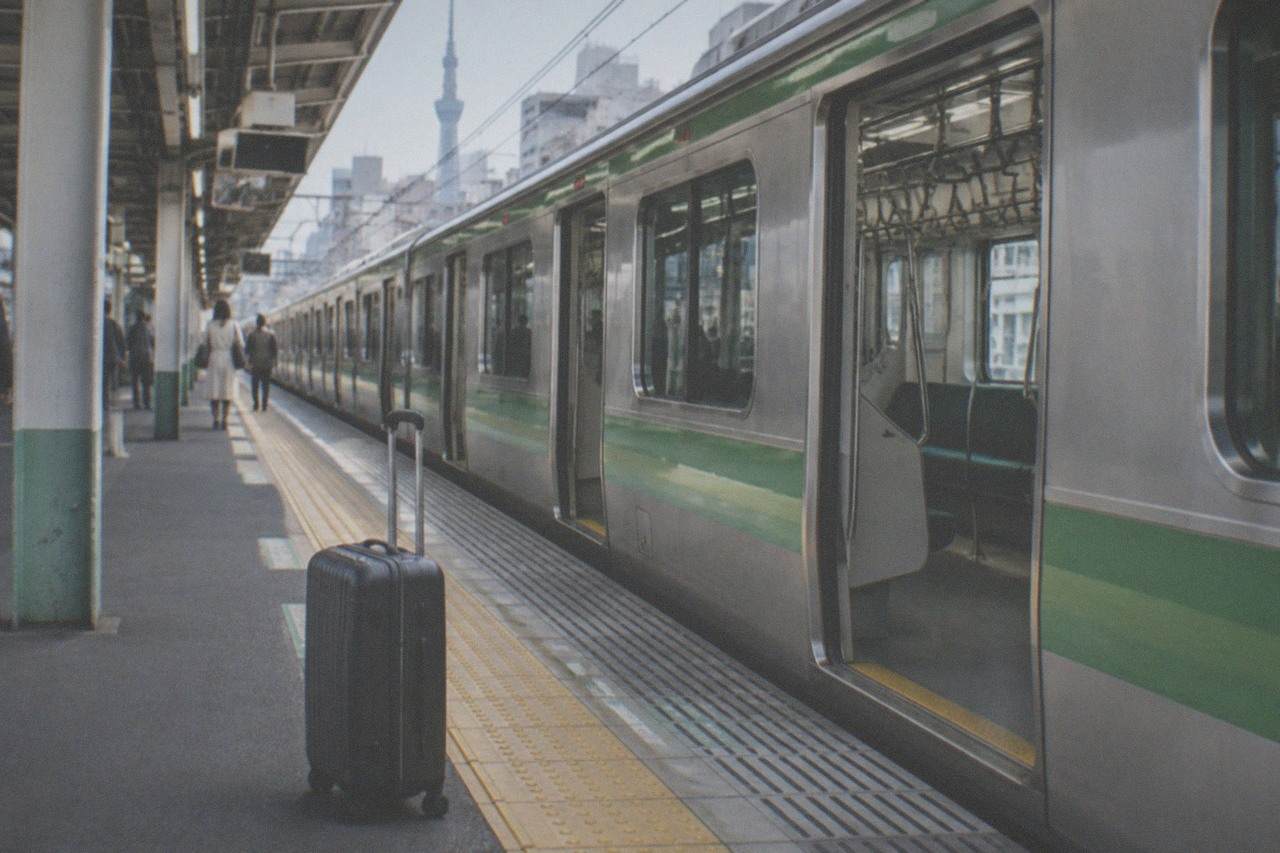
Short answer
You can carry any size of suitcase on the Tokyo Metro, with no published size or weight limit. A Tokyo Metro coin locker costs 900 to 1,000 yen per day for its largest tier, which fits a large suitcase, and can be used for up to 4 days including the start day. Staffed baggage rooms exist only at a few JR stations, priced 500 to 2,000 yen per day.
Can You Take A Suitcase On The Tokyo Metro?
Yes, and there is no size rule to break. Tokyo Metro publishes no luggage size limit, no weight limit and no extra charge for a suitcase on its trains. The only hard limits in Tokyo belong to the Shinkansen, at 160 cm before a mandatory seat reservation applies, and to individual venues like Tokyo Skytree, which turns away any bag with a side over 60 cm.
For a visitor arriving at Narita or Haneda with one checked case, the Metro is a legal and usually workable option. Nobody at the gate measures your bag, and the fare is the same whether you board empty-handed or with a 29-inch spinner. The operator's own etiquette guidance asks for courtesy toward other passengers, and that is the whole of the policy.
The practical question is not permission but physics. Metro cars were designed for commuter volume, not luggage, and the busiest interchanges process millions of passengers a day through corridors and stairways where a wheeled case is a genuine obstacle. A visitor dragging a suitcase through Shinjuku at 8:30 on a weekday morning is a problem for everyone nearby, including themselves.
That is the reason this page exists. Luggage on Japanese trains is famously painless on the Shinkansen and on suburban JR lines at off-peak times, and that reputation travels further than the fine print. The Metro is a different machine, with tighter cars, tighter gates and no oversized-baggage infrastructure at all, and the smart move is usually to park the case before you ride.
Is There A Luggage Size Limit On Japanese Trains?
On the Tokyo Metro and on JR commuter trains, no: any size goes, free, with no reservation. On the Shinkansen, yes: a bag over 160 cm in three-side total requires a free but mandatory oversized-baggage seat reservation, and nothing over 250 cm or 30 kg rides at all. Riding without the reservation costs a 1,000 yen carry-on fee per journey.
The Shinkansen rule is the only formal size regime on Japanese railways, and it applies only to the Tokaido, Sanyo, Kyushu and Nishi-Kyushu lines, the ones out of Tokyo toward Kyoto and Osaka. JR East's Shinkansen lines north of the capital have no reservation requirement and no fee for suitcases within the standard allowance of two items, each up to 250 cm and 30 kg, but no reservation also means no guaranteed space, since the storage areas on those trains are first come and cannot be booked. The full policy detail, including what changed in July 2025, is covered in the site's guide to Shinkansen oversized baggage rules.
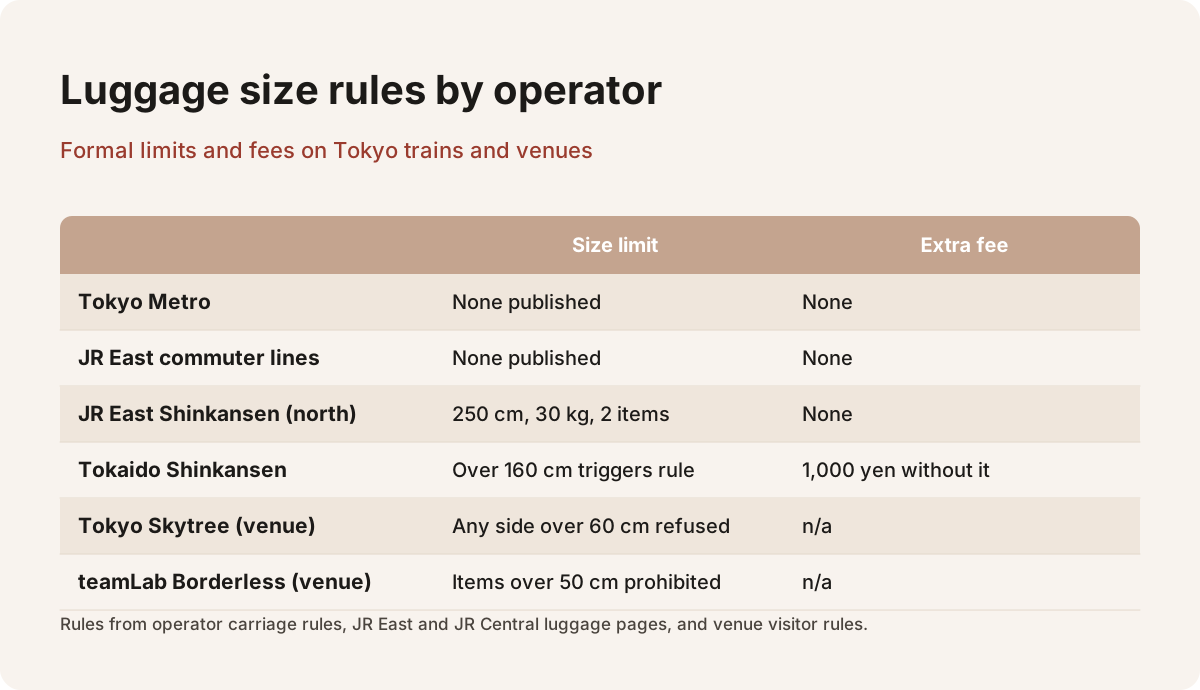
Below Shinkansen speed, every operator in Tokyo, Metro, Toei, JR East and the private railways, treats a suitcase as ordinary hand luggage. The table shows where rules actually bite.
| Service | Size limit | Reservation | Extra fee | Source of the rule |
|---|---|---|---|---|
| Tokyo Metro | None published | No | None | Operator carriage rules |
| JR East commuter lines | None published | No | None | Operator carriage rules |
| JR East Shinkansen (north) | 250 cm, 30 kg, 2 items | No, no guaranteed space | None | JR East luggage-area guide |
| Tokaido Shinkansen | Over 160 cm triggers rule, 250 cm absolute | Mandatory, free | 1,000 yen without it | JR Central oversized-baggage page |
| Tokyo Skytree (venue) | Any side over 60 cm refused | n/a | n/a | Venue visitor rules |
| teamLab Borderless (venue) | Items over 50 cm prohibited | n/a | n/a | Venue FAQ |
Notice the pattern: the restrictions all come from buildings and long-distance trains, not from the commuter network. A museum will refuse your suitcase at the gate, a bullet train will charge you for skipping a reservation, and a Metro train will simply let you on and leave you to manage.
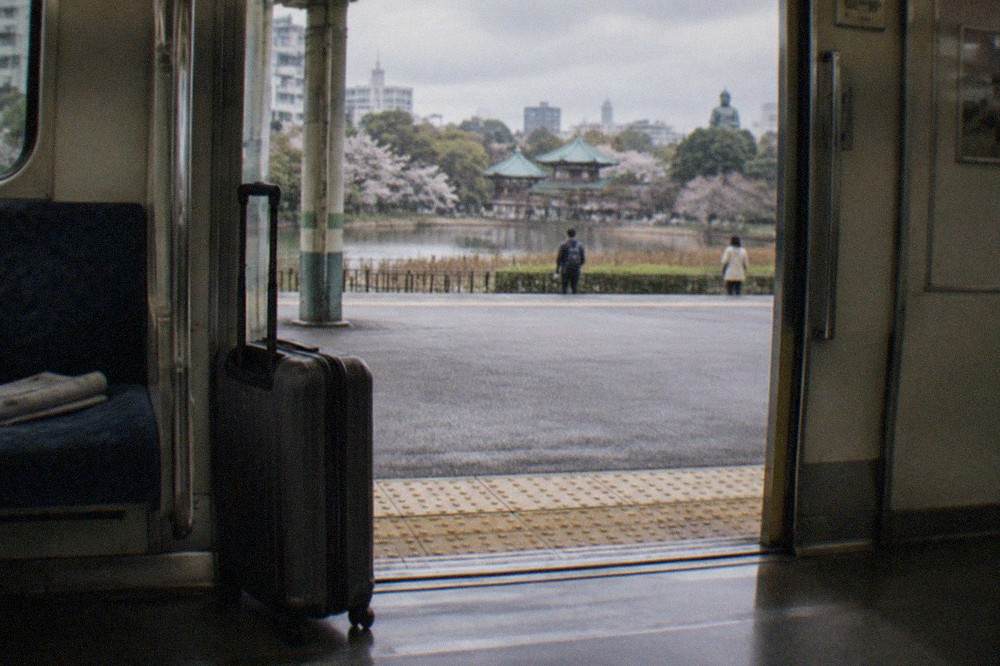
If your case is staying in Tokyo, in other words, the size rules barely matter. What matters is the crowd you carry it through, and that is worth planning for.
When Are Tokyo Metro Trains Too Crowded For A Suitcase?
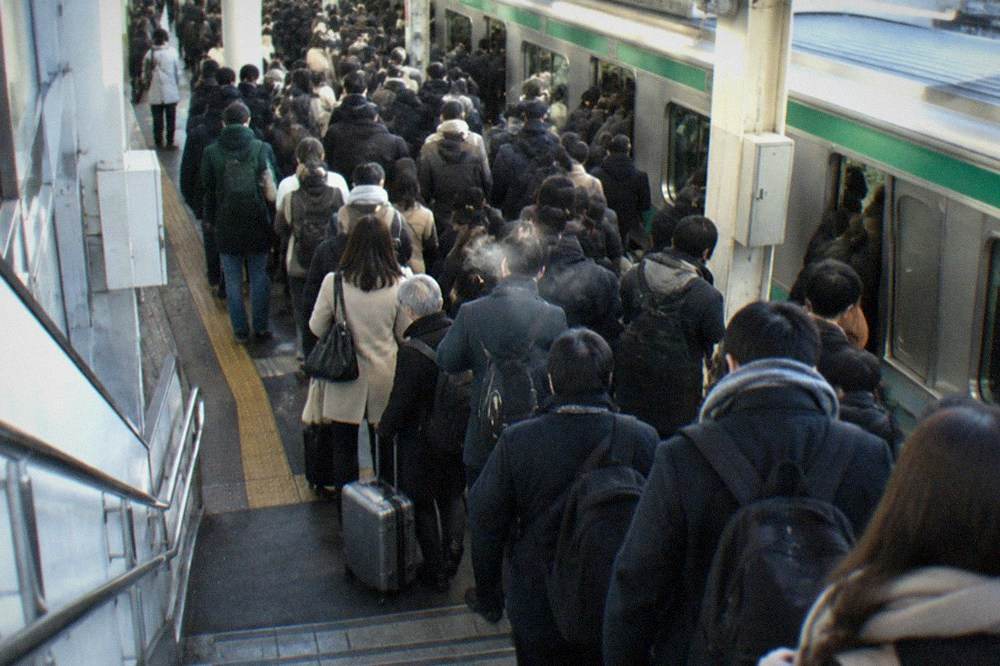
Peak crush runs roughly 7:30 to 9:00 in the morning and 17:30 to 19:30 in the evening on weekdays, when central Tokyo trains are at their fullest and staff are deployed to push cars closed. Late morning, early afternoon and weekends are calm enough that a suitcase is a minor inconvenience. A visitor with a choice should simply not ride into a terminal station before 9:30 on a weekday.
The morning peak is the harder of the two for luggage, because the flow is one-directional: everyone is heading the same way you are, into the centre, and the cars do not empty between stations. An evening peak at least thins as trains move outward. The worst interchanges for a wheeled case are the giant transfer complexes, Shinjuku, Shibuya, Ikebukuro and Tokyo Station, where the walk between lines can be several minutes of corridor with stairs.
Escalators and stairs are the pinch points. Not every Metro interchange has a lift at the platform you arrive at, and finding one can mean a detour through back corridors. The tactile paving strips on platforms exist to guide visually impaired passengers, and a suitcase parked on them blocks that function, so keep the bag close and off the yellow tiles. Stand the case in front of you rather than beside you where possible.
Two practical habits make the ride humane. First, ride toward the front or rear car of the train, where crowds are measurably thinner. Second, board at the far end of the platform from the stairs, where fewer people queue. Neither is official advice, but both are what experienced commuters do, and a suitcase makes every crowd problem on the platform worse.
The alternative, of course, is not to carry the case at all. Tokyo's storage and forwarding options are dense enough that the usual best answer to a Metro ride with luggage is to remove the luggage from the equation, and the rest of this page is about which removal method fits which situation.
Should You Store The Suitcase Instead Of Carrying It?
For a day of sightseeing, yes: staffed storage through Radical Storage costs 850 yen per bag per day at 244 of its 249 Tokyo points, plus a one-off 355 yen checkout fee per bag, so one bag for one day is 850 plus 355, or 1,205 yen in total. For a longer gap between hotels, forwarding by takuhaibin usually beats both storing and carrying.
That price is the like-for-like figure for a regular suitcase, and the checkout fee does not scale with days, so a three-day booking is 850 times three plus 355. Radical Storage advertises from 490 yen per day, but that is a small-bag rate published at only 11 points, and it should not be read as what suitcase storage in Tokyo costs. Most points in the network are staffed Radical Storage partner locations, a shop or hotel desk where people take the bag in person, though some Radical Storage points are lockers, and this site is an independent guide with no storage points of its own, not an operator.
The point network maps well onto the Metro system. In Asakusa there are 13 points, the nearest 193 m from the station, rated 4.85 from 268 reviews. Near Ueno Station there are 8 points, the nearest 171 m, rated 4.87 from 285 reviews. Near Akihabara Station the count is 9, with the nearest point 31 m from the gates, rated 4.88 from 171 reviews. Hours are set point by point, and 146 of the 249 Tokyo points are not open 24 hours, so the closing time on each point's own page matters before you plan an evening around it.
One caution belongs here: the guarantee. Radical Storage's terms state that its guarantee is not insurance, that the company can withdraw it, and that payouts are capped at EUR 3,000 per claim. Store a normal suitcase and nothing of high value, which is the same advice that applies to every storage method in this city.
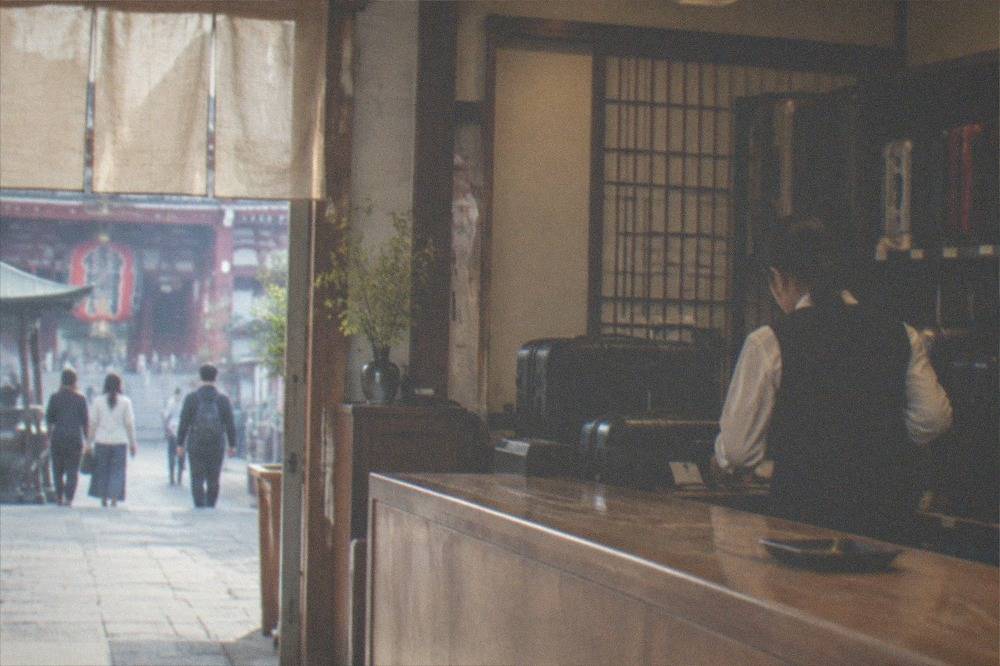
Asakusa deserves its place as the first stop on that list. It is the neighbourhood where the Metro, the Toei subway, the Tobu line and the biggest temple attraction in the city all meet, which makes it both the most useful place to park a bag in eastern Tokyo and the place where a wheeled case does the most damage to a crowd. Thirteen staffed points inside a few hundred metres of the gates is a depth of coverage most districts cannot match.
If Asakusa is the eastern anchor, the same logic applies at the northern and central terminals. Ueno's eight points cluster around the Park Gate side of the station, where the museum corridor and the zoo make a suitcase pointless within minutes of arriving, and the drop-off desks there sit close enough to the JR interchange that a transfer from a Metro line costs a couple of minutes' walk. It is the pattern to copy anywhere in the city: park the case at the station whose attractions end your ride, not at the one where your ride begins.
What Do Coin Lockers At Metro Stations Cost, And How Long Can They Hold A Bag?
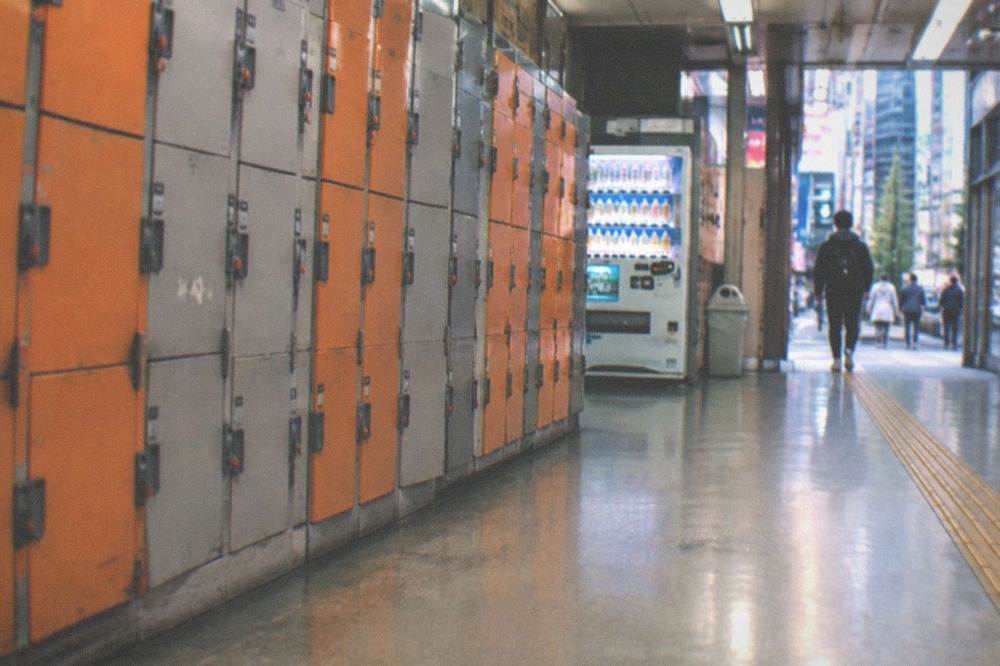
Tokyo Metro charges one price ladder at every one of its stations: 300, 500, 600, 900 and 1,000 yen per day by door size, and a large locker that fits a suitcase costs 900 or 1,000 yen. The maximum rental is 4 days including the start day, and the day-counting clock adds a day at 2 a.m., not midnight.
The single-ladder point is worth dwelling on because almost every English-language guide gets it wrong. Tokyo Metro's locker tariff, published by its operator Metro Commerce, is the same at all 141 station rows on the tariff page; only the mix of door sizes varies by station. There is no station-hunting to be done for a cheaper locker inside the Metro network. The guide to coin locker sizes covers the door dimensions in detail, but the short version is that only the two top tiers, at 900 and 1,000 yen, swallow a checked suitcase.
| Operator | Price ladder | Large-door price | Max duration | Day rolls at |
|---|---|---|---|---|
| Tokyo Metro | 300 / 500 / 600 / 900 / 1,000 yen | 900 to 1,000 yen | 4 days incl. start day | 02:00 |
| JR East (station-dependent) | SS 300-400 up to LW 800-1,000 yen | 800 to 1,000 yen (LW) | 3 days (Multi Ecube) | 02:00 |
| Narita Airport lockers | 400 / 600 / 800 yen | 800 yen | 8 days | midnight |
| Haneda T1/T2 lockers | 400 to 1,500 yen per day | 1,000 to 1,500 yen | 7 days | 24h boundary |
JR East lockers, the ones in JR stations you may transfer through, do vary by station, and the operator's own data shows Tokyo and Shinjuku at 700 yen for a medium door against 600 yen at Omiya, with a 100 to 200 yen peak-season surcharge on the larger doors. Reserving a Multi Ecube locker in advance costs a further flat 500 yen per box. Everything else covered here is indexed on Luggage Storage in Tokyo.
The duration rules are where lockers punish the unwary. Four days sounds like plenty until you read the terms: the period is counted including the day you start, the first and last day each count as a full day however briefly you used them, and on JR East's Multi Ecube boxes paying more does not extend the period, the bag must be out by day four regardless. After expiry the operator opens the locker, moves the contents to a separate store, and continues charging the same daily rate for up to 30 days, after which the contents are deemed abandoned. Collecting from separate storage requires the receipt, photo ID, the same IC card you paid with, and cash only for the additional fee.
Liability is the quiet part of the deal. Every major locker operator in Tokyo, Metro Commerce, JR East Smart Logistics, Tokyu and Keio, caps compensation at 30,000 yen, and their terms prohibit storing anything worth 30,000 yen or more in the first place, so the cap and the ban are the same number by design. A locker is for a suitcase of clothes, not a laptop bag. The full picture of what that means is in the safety guide for Tokyo luggage storage.
Why Are The Large Lockers Always Full?
Because there are few of them, and everyone wants one at the same time. Tokyo Metro has 4,830 locker doors across its whole network, but at Asakusa it lists just 57, at Shinjuku 52, and large suitcase-capable doors are a small fraction of each bank. The shortage is concentrated at exactly the stations a visitor uses, and it peaks from mid-morning onward.
The counts are worth stating precisely, because English coverage routinely inflates them. When JR East says Ueno has 19 lockers, it means 19 locations, nineteen banks, while Tokyo Metro alone lists 127 individual doors at Ueno. A count of locations is not a count of lockers, and neither is a count of doors the same as a count of large doors. The guide to why Tokyo coin lockers are full goes deeper, but the numbers tell most of the story.
| Station | Locker doors (Tokyo Metro) | Suitcase-capable share | Staffed baggage room at the JR station |
|---|---|---|---|
| Shibuya | 146 | minority | none listed by any operator |
| Ueno | 127 | minority | yes, 3F, 500 to 2,000 yen |
| Tokyo | 100 | minority | yes, seven counters |
| Asakusa | 57 | minority | Tobu information centre, price unconfirmed |
| Shinjuku | 52 | minority | none listed by JR itself |
The pattern in the last column is the one most coverage misses. Attended baggage rooms in Tokyo are concentrated at Tokyo Station, which has seven, including counters at Yaesu South, Gransta B1 and the Shinkansen South Transfer Gate, all running the same 500, 1,000 and 2,000 yen tiers for up to 30 days, with hours between 09:30 and 20:00. JR East's own Travel Service Center page states its luggage storage is available at Tokyo Station only, which disposes of Shinjuku, Shibuya and Ikebukuro at a stroke. Ueno has a JR East Logistics room inside the Park Gate, and Shinagawa has one inside the Central Gate with weekday discounts of 800 yen on a medium bag, though weekend pricing applies on the forced-peak dates in late April to early May, mid-August and the New Year window.
When a large locker bank at a Metro station is empty by 10:30, as it routinely is at Asakusa and Shibuya, the staffed options are the fallback, and the two live availability services are worth knowing: Tokyo Metro's own Locker Concierge shows open doors across its network, and JR East's multiecube site does the same for its boxes.
What If The Bag Needs To Be Somewhere Else Entirely?
Forwarding it is often cheaper than a week of storage. Yamato's takuhaibin, the luggage forwarding service, sends a suitcase from Tokyo to Tokyo from 1,730 yen in the 120 cm band, and Tokyo to Kyoto or Osaka from 2,170 yen, with the tariff capped at a 200 cm total and 30 kg. The trade-off is timing: transit times are not published for personal customers, so a forwarded bag needs a receiving address and a spare day.
The mechanics are simple in practice. You hand the case, or a hotel hands it, to Yamato, Sagawa or Japan Post, and it travels to your next hotel, an airport counter or a home address. Within Tokyo the 120 band costs 1,730 yen, the 140 band 2,090 yen, the 160 band 2,410 yen, and the 180 band 3,030 yen. To the Kansai zone, Kyoto and Osaka share one tariff, the same bands cost 2,170, 2,780, 3,160 and 4,480 yen. Sagawa is the only one of the carriers that takes genuinely oversized cases, up to 260 cm and 50 kg, which matters if your bag is beyond Yamato's ceiling. The full comparison, including the route-specific detail, is in the site's guide to sending luggage from Tokyo to Kyoto.
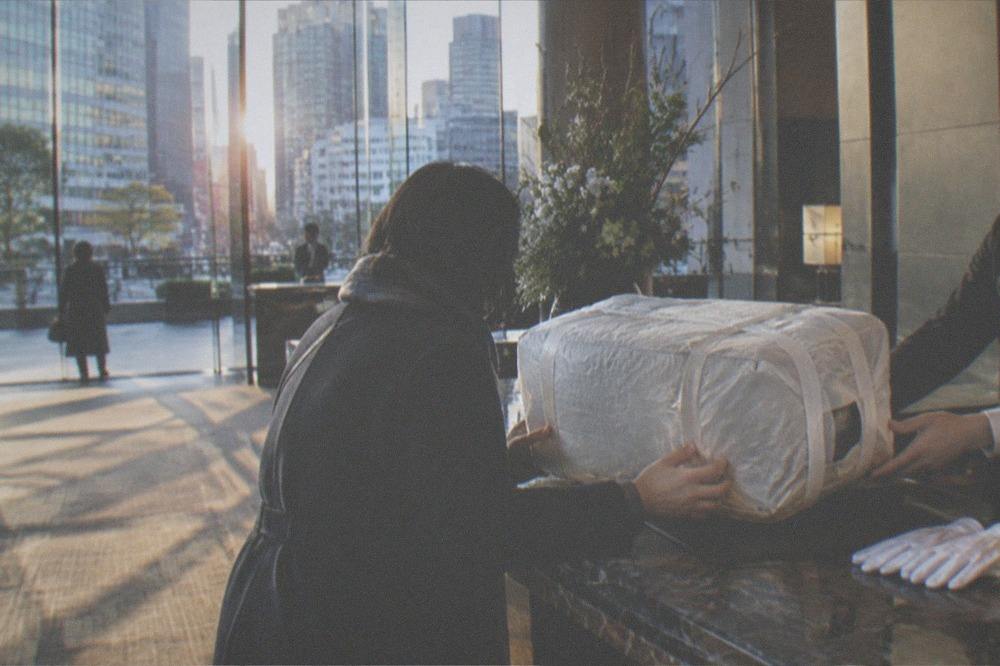
Forwarding and storage solve different halves of the problem, and the forwarding versus storage comparison sets out the decision in full. The short form: storage wins for a few hours or a day when you return for the bag; forwarding wins for a gap of several days, or when the alternative is dragging a case across the city twice.
For the day-trip case, storage near the station you actually leave from is the pattern that works. Akihabara's nine Radical Storage points, the nearest 31 m from the station, make it a practical base for a hands-free afternoon, and the district's rating of 4.88 from 171 reviews reflects a deep, well-reviewed pool rather than a thin one.
Ueno plays the same role one interchange north, and in some ways a stronger one. Its eight points sit close to the Park Gate baggage room, so a visitor who arrives early, before the locker banks have turned over, has a staffed fallback inside the station itself, and the museum corridor beyond the gate is walkable with empty hands. The rating of 4.87 from 285 reviews is the second-deepest pool in the districts group, which matters more than a decimal when you are choosing where to hand over a suitcase.
How To Ride The Metro With A Suitcase Without Misery
Board outside the peaks, use the lift where one exists, and keep the case in front of you in the least crowded car. The three moves that prevent the worst outcomes are simple: check the locker or storage plan before you ride, validate that your destination venue even admits a suitcase, and never ride into a morning peak with a checked bag when the alternative is a 1,205 yen drop-off.
Venue rules are the checkpoint most visitors skip. Tokyo Skytree prohibits any item with a side over 60 cm and enforces it with bag inspection at entry, so a cabin bag at about 55 cm passes and a checked case does not. teamLab Borderless prohibits items over 50 cm. The Mori Art Museum has no cloakroom at all and free lockers on floor 52, whose largest interiors measure 370 x 430 x 810 mm. Tokyo National Museum's Japanese page refuses suitcases from the grounds entirely, at the Main Gate, while its English page implies only the buildings are covered, a disagreement worth knowing before you wheel up. The storage map of Tokyo shows the drop-off points nearest each of these venues.
Payment for lockers is the last mechanical detail. Metro Commerce's terms say to pay by whatever method is displayed on the locker body itself, and at JR stations most banks take cash and IC cards, with some transit-IC-only banks and a few taking QR and e-money options. Keep the paper ticket: JR East's own FAQ says the printed retrieval slip unlocks the door regardless of how you paid, which resolves a genuine conflict between two of its official pages in favour of holding the ticket. If both ticket and card are lost, the Multi Ecube helpline is 0120-829-532, 08:00 to 21:00, and it needs the four-digit door number.
The honest summary is that the Tokyo Metro is a fine place for a suitcase at the right hour and a miserable one at the wrong hour, and that Tokyo gives you unusually good ways to never find out which. Store the case near the station, forward it to the next hotel, or time the ride between the peaks, in that order of preference, and the size question that started this page never really arises.
Common Questions About Suitcases On The Tokyo Metro
Can I take a large suitcase on the Tokyo Metro?
Yes. Tokyo Metro publishes no size or weight limit for luggage on its trains, and there is no extra charge. The constraints are practical: peak-hour crowds between 7:30 and 9:00 and 17:30 and 19:30, narrow corridors at major interchanges, and venue rules at your destination, several of which refuse bags well under checked-suitcase size.
Is there a luggage limit on Japanese trains?
On commuter trains in Tokyo, no size limit is published by any operator. The only formal limit is on the Shinkansen: a bag over 160 cm in three-side total requires a free oversized-baggage seat reservation on the Tokaido, Sanyo, Kyushu and Nishi-Kyushu lines, nothing over 250 cm or 30 kg is carried, and boarding without the reservation costs a 1,000 yen fee per journey.
How much is a large coin locker at a Tokyo Metro station?
Tokyo Metro charges the same ladder at every station: 300, 500, 600, 900 and 1,000 yen per day by door size. A door large enough for a checked suitcase costs 900 or 1,000 yen per day. JR East lockers vary by station, with large doors between roughly 700 and 1,100 yen and a 100 to 200 yen peak-season surcharge.
How long can I leave a bag in a Tokyo Metro coin locker?
Four days including the day you start, with the day-counting clock adding a day at 2 a.m. rather than midnight. After that the operator opens the locker and moves the contents to separate storage, where the same daily rate keeps running for up to 30 days, collection requires the receipt, photo ID and the IC card you paid with, and the separate storage fee is cash only.
Is a station baggage room cheaper than a locker?
Usually not, but it lasts longer. JR East Logistics rooms at Tokyo and Ueno charge 500, 1,000 or 2,000 yen per day by size and hold a bag for 30 days, against 900 or 1,000 yen for a large locker that holds it for four. But these rooms exist only at a handful of stations; JR East's own page states its Travel Service Center storage is available at Tokyo Station only.
What is the alternative to carrying a suitcase on the Metro?
Staffed storage through Radical Storage costs 850 yen per bag per day at 244 of its 249 Tokyo points, plus a one-off 355 yen fee per bag, so one bag for one day is 1,205 yen in total. For longer gaps, takuhaibin forwarding sends a suitcase from Tokyo to Kyoto or Osaka from 2,170 yen in the smallest suitcase band, though transit times are not published.