Can I Leave My Luggage At A Hotel I'm Not Staying At?
Yes, often. Tokyo front desks hold bags for non-guests more readily than in many countries, but it is a courtesy, not a service with a tariff. Here is when hotels say yes, what to say, and what to do when the answer is no.
Can I Leave My Luggage At A Hotel I'm Not Staying At?
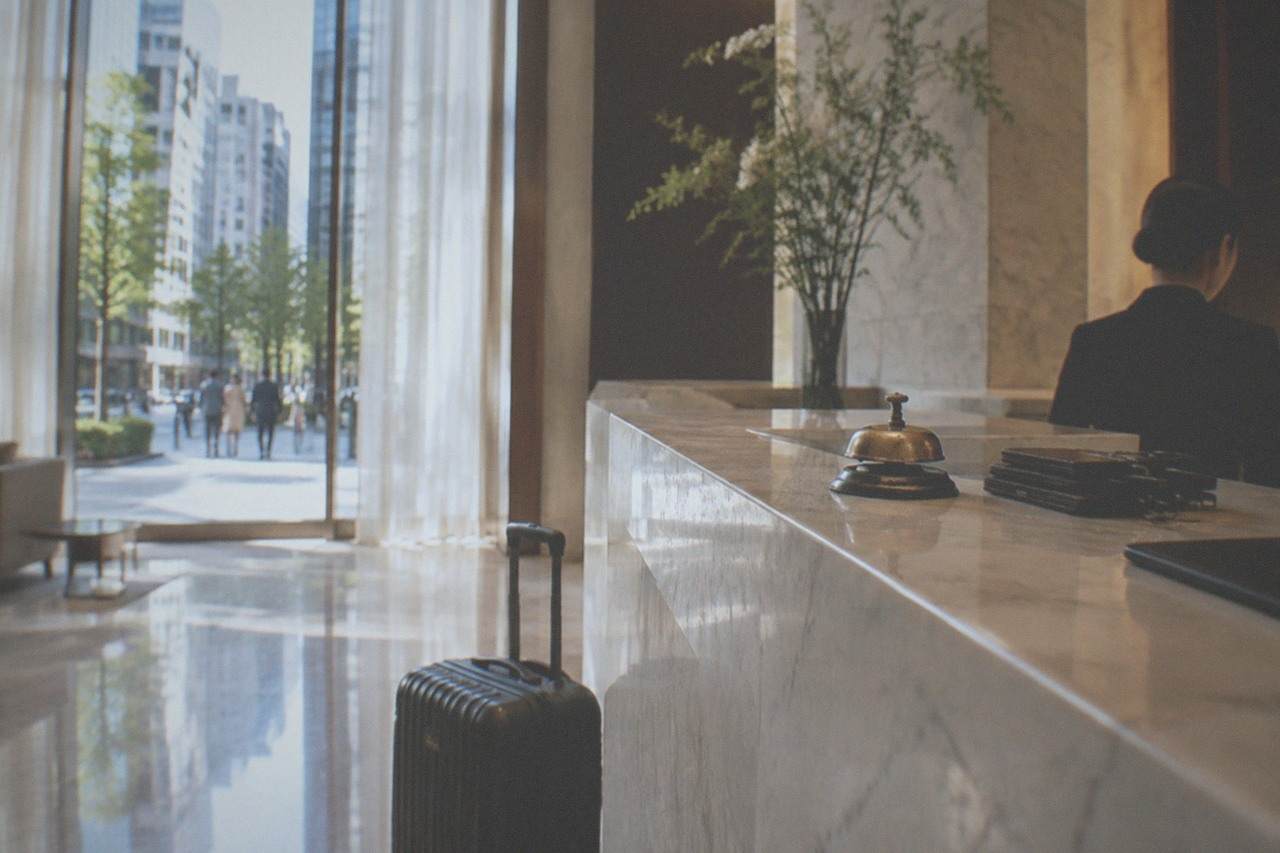
Usually yes, if you ask the right way and pick the right moment. Many Tokyo front desks will hold a suitcase for a non-guest for a few hours, and hotels do this more readily in Japan than in most of Europe or North America. But it is always a courtesy: there is no published tariff, no receipt in the usual sense, and no compensation scheme behind it, so the desk can also simply say no.
There is no rule that stops a Tokyo hotel from taking your bag. What stops it in practice is the desk's own judgement: how busy the lobby is, whether the hotel has a baggage room at all, whether you arrive with one wheeled case or four, and whether you can make yourself understood. A calm request, a small bag, and a mid-morning arrival on a weekday will usually get a yes. The same request at 15:00 on a check-in Saturday, with a party of five and two oversized duffels, will often get a polite refusal, and the desk is within its rights to refuse.
The pattern that works most reliably is a hotel that has some connection to you. A property where you stayed last week, or where you are staying next week, will very often keep a bag for the in-between day. A hotel that is nothing to you, in a neighbourhood you are only passing through, is a coin flip. Luxury properties with a proper bell desk and a luggage room say yes more often than a business hotel with a two-person front desk and no storage space behind the counter, though the luxury desk is also the one most likely to be protecting that space for its own guests.
Two honest caveats before the practical detail. First, nothing about a courtesy hold is documented: if the hotel takes the bag, note whether you get a numbered tag, and take a photo of the bag at the desk. Second, this is a question a lot of English-language coverage answers with a flat "hotels in Japan always do this", and that is not what the evidence supports. Operators publish tariffs for their attended counters and their lockers, but no Tokyo hotel chain publishes a policy for non-guest bag holds, which tells you the answer genuinely varies desk by desk.
If you would rather have a documented drop-off with a printed booking, the paid alternative is a staffed Radical Storage point, and the clusters closest to the big hotel districts are worth knowing before you start walking lobbies.
When Will A Tokyo Front Desk Say Yes, And What Should You Ask For?
Say yes most often: the hotel you have already booked, a hotel of the same chain, and large properties with a bell desk. Say no most often: small business hotels at peak check-in hours, and any desk being asked to hold a bag overnight. Ask for a short, same-day hold, one or two bags, and offer to collect before the evening shift.
Work down this ladder, in order.
A hotel you are staying at, before check-in or after check-out. This is not really a non-guest hold at all, it is a standard guest service, and virtually every Tokyo hotel does it. The relevant planning detail is the gap: most Tokyo hotel check-in times run mid-afternoon, and the Tokyo hotel check-in times guide covers the window between an early arrival and the hour your room is ready.
A hotel you have just checked out of, for the day. Also standard. The desk already knows you, the bag was in their custody last night, and holding it until your evening train costs them a corner of the luggage room. This is the single most reliable non-booking hold in the city.
A different property of the same chain. Chains move bags between their own hotels as a matter of course for takuhaibin, luggage forwarding, so a sister property's desk tends to treat a non-guest of the same brand as a near-guest. It is not guaranteed, and no chain publishes it as a service, but it fails far less often than a cold ask at an unrelated hotel.
A large hotel near a station, for a few daytime hours. The bell desk exists, the room exists, and a single suitcase for four hours is invisible to their operation. Walk in mid-morning, ask at the bell desk rather than the check-in counter if the two are separate, and have the bag closed and tagged.
What makes a desk say no has less to do with you than with the clock. Tokyo check-in concentrates between 14:00 and 16:00 and check-out between 10:00 and 11:00, and a desk running both at once is not going to add a stranger's bag to the pile. Overnight is the other hard line: a same-day hold is a courtesy, but an overnight hold of a stranger's bag starts to look like a responsibility, and desks know it. If you need the bag kept until tomorrow, skip the hotel and use a paid option, which is what the rest of this page is for.
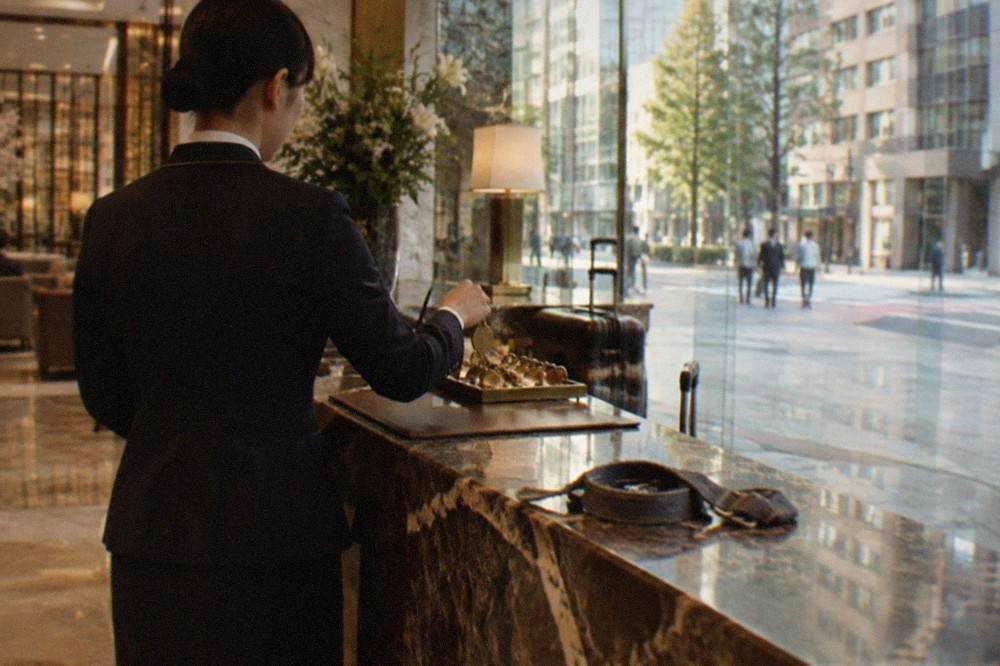
For the request itself, the phrase matters less than the shape of it: one bag, a stated pick-up time, and a stated reason. A one-line script in Japanese, with the key words written out, is in the guide to asking a hotel to store luggage in Japanese, and even mangled pronunciation of "azukete itadakemasu ka" works far better than mime, because it tells the desk immediately that you are asking for a hold and not for a room.
What Does It Cost, And What Are You Actually Being Promised?
A courtesy hold is normally free, and some desks will not accept money for it. Where a hotel does charge, there is no published city-wide price, so treat any figure you are quoted as that hotel's own number. What you are being promised, at best, is that a bag is behind a counter. There is no receipt-based compensation scheme for a courtesy hold, unlike the paid alternatives, whose terms are written down.
The economics of the free hold are the reason hotels do it. A bell desk is staffed anyway, the luggage room is there for guests, and a bag in the corner costs the hotel nothing but a few seconds of attention. That is also the ceiling on what you can complain about later. If a courtesy bag goes missing, you are in the territory of general Japanese consumer law, not a storage contract: the Commercial Code applies a duty of care even to storage provided free of charge by a business that accommodates customers, and the Consumer Contract Act voids clauses that try to wipe out liability entirely. Both are real protections. Neither is a substitute for a ticket with terms on it.
That contrast is worth spelling out, because the paid alternatives in Tokyo are unusually well documented. Every coin locker operator publishes a liability cap of 30,000 yen in its terms, a contractual number rather than a statutory one. The station baggage rooms at Tokyo Station publish size tiers, 500, 1,000 and 2,000 yen per bag per day, and a 30-day maximum. Radical Storage's network runs on a written guarantee that its own terms say is not insurance, with payouts capped at EUR 3,000 per claim, and the terms allow Radical Storage to withdraw the guarantee at any time. A hotel desk holding your bag as a favour promises you none of this, which is fine for a backpack with a jumper in it and a poor plan for a case with a laptop.
A rough decision table, using only figures operators publish:
| Option | Typical cost | What is written down | Best for |
|---|---|---|---|
| Hotel courtesy hold | Usually free, hotel's own figure if charged | Nothing binding | A few hours, low-value bag, hotel you know |
| Station baggage room (Tokyo Station) | 500 / 1,000 / 2,000 yen per bag per day by size, up to 30 days | Full operator tariff and terms | A full day or multi-day hold near the station |
| Coin locker (Tokyo Metro) | 300 to 1,000 yen per day by tier, one price ladder at every Metro station | Published terms, 30,000 yen liability cap | One day, bag fits the 342 mm depth |
| Radical Storage point | 850 yen per bag per day plus a 355 yen per-bag checkout fee | Network guarantee terms, capped at EUR 3,000 per claim | Staffed drop-off outside station hours, oversized bags |
The Paid Backup: Staffed Storage Points That Take Walk-Ins
When a front desk says no, the paid fallback is a staffed Radical Storage point, a station baggage room, or a coin locker, roughly in that order of flexibility. The real rate for a regular bag is 850 yen per day at 244 of the 249 Tokyo points on file, plus a 355 yen per-bag fee charged once at checkout, so one bag for one day is 1,205 yen.
The network's own advertising says "from 490 yen per day", and that number deserves one careful sentence: it is a small-bag rate found at 11 Tokyo points, not what a traveller with a normal suitcase pays. Radical Storage also displays 750 yen on some staffed point cards, which is the same small-bag tier shown at those points, not a cheaper price for the same bag. The like-for-like figure for a regular suitcase is 850, everywhere, and the 355 yen checkout fee applies once per bag no matter how many days you stay.
Why choose a staffed point over a locker? Size, mainly. A coin locker's binding constraint is depth: Tokyo Metro and Toei lockers are about 342 mm deep internally, and a JR East Multi Ecube locker is 340 mm, so a wide hard-shell suitcase fails the depth even when the width looks fine. A staffed point takes the bag as it is. Hours are the other reason: 146 of the 249 Tokyo points are not open 24 hours, so check the specific point's hours before relying on one, and do not assume the network's page titles, which promise "24/7", describe any particular location.
In Roppongi, three staffed points serve the station, the nearest about 199 m away, rated 4.88 across 47 reviews, which is a small but strong pool. Roppongi is also the cluster that serves the Azabudai Hills and teamLab Borderless crowd, and teamLab Borderless refuses items over 50 cm at the door, so the bag has to go somewhere before the visit.
Asakusa is the deepest cluster in the network: 13 staffed points, the nearest about 193 m from the centre, rated 4.85 across 268 reviews. It matters here for a negative reason. The Asakusa Culture Tourist Information Center, which held travellers' bags free for years, terminated that service on 31 March 2026, with Taito City citing congestion from suitcases on the streets around Kaminarimon. A lot of older English content still sends readers there. If your plan was the free information-centre hold in Asakusa, that plan no longer exists, and the paid points, or the Sagawa counter described below, are what replaced it.
Station Baggage Rooms: The Documented Hotel-Style Alternative
If the hotel says no and you want a human being taking custody of the bag with a tariff behind it, the station baggage rooms are the closest thing. Tokyo Station has seven attended facilities, from 500 yen per bag per day up to 2,000 yen, with a 30-day maximum at the JR East Logistics counters. Ueno has one inside the Park Gate, Shinagawa has one inside the Central Gate, but Shibuya, Ikebukuro and JR Shinjuku have none.
That concentration surprises people. Tokyo Station's Yaesu South counter, the Gransta B1 facility, the Shinkansen South Transfer Gate counter, the Marunouchi Central counter and others add up to seven separate desks within one station, while the other giant stations of the west and north have nothing of their own on the JR side. JR East's own travel-centre pages state that travel-centre luggage storage is available at Tokyo Station only, which settles the question for the Shinjuku, Shibuya, Ikebukuro and Ueno travel service centres at a stroke. Shinjuku does have an Odakyu counter at the West Exit that publishes no price at all, deliberately, with a three-day maximum, and a Sagawa counter in the Busta tourist centre at 800 to 1,500 yen per day, but neither is a JR baggage room.
The Shinagawa counter has a wrinkle worth knowing: its weekday rate for a medium bag is 800 yen against 1,000 on weekends, and the weekend rate is forced onto certain weekdays, 27 April to 6 May, 10 to 19 August, and 28 December to 6 January, so a Golden Week drop pays the weekend price. Ueno's counter runs 10:00 to 20:00 daily at the standard 500 / 1,000 / 2,000 tiers, inside the Park Gate, which means you need to be inside the paid area or willing to go through it.
Outside the JR world, Sagawa Express runs attended counters with published prices that behave like mini baggage rooms. The one at Kaminarimon in Asakusa charges 800 yen per day with no size tiers, which is the simplest published attended price in the city. The one at Tokyo Skytree's Solamachi charges 800 yen for a bag up to 100 cm, 1,000 up to 160 cm, and 1,300 beyond that, running 10:00 to 21:00. Skytree itself refuses any item with a side over 60 cm at inspection, so that counter, or a nearby storage point, is not optional if you arrive with a checked suitcase.
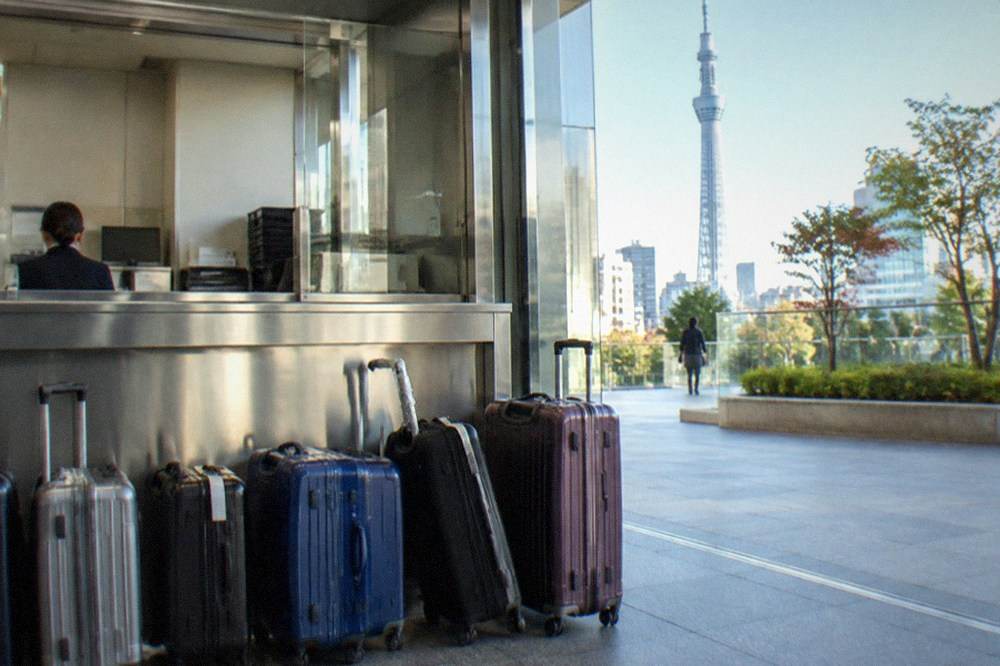
One more cluster worth naming here, from Luggage Storage in Tokyo: the district around Tokyo Skytree carries three staffed Radical Storage points, the nearest about 85 m out, rated 4.77 across 132 reviews, which is a real pool and a short walk if the Sagawa counter's hours have finished.
Forwarding The Bag Instead Of Parking It
If you want a hotel to hold the bag because you are between hotels, forwarding may beat storage. Yamato TA-Q-BIN sends a suitcase within Tokyo from 1,730 yen for the 120 size band, and Tokyo to Kyoto or Osaka from 2,170 yen, the band set by the greater of the three-side total or the weight. Transit times are not published for any lane, so never plan on a delivery time the operator does not state.
The mechanics are simple and the prices are real. Yamato's size bands run from 60, meaning up to 60 cm and 2 kg, to 200, meaning up to 200 cm total and 30 kg, and any one side is capped at 170 cm. A typical mid-size suitcase measures into the 140 or 160 band. Within Tokyo, the 140 band is 2,090 yen and the 160 band is 2,410 yen. To Kyoto or Osaka, which share one tariff zone, the 140 band is 2,780 yen and the 160 band is 3,160 yen. Carrying the parcel to a branch or a convenience store yourself takes 100 yen off, and only Seven-Eleven and FamilyMart take Yamato parcels: Lawson routes to Japan Post, not Yamato.
The two constraints a hotel-centred plan needs to know. First, Yamato's rule for unstaffed lodging is strict: no delivery to an Airbnb, minpaku or unstaffed property unless someone will certainly be there to receive it, and no convenience-store handover for this product. If your next stop is an apartment with a keypad, forwarding to it does not work in the way it does to a hotel desk. Second, the timing. Sagawa will forward a bag from a Tokyo counter to Narita, and Yamato will deliver from Haneda to a hotel, but Yamato states plainly that it does not do same-day delivery from the city to Narita, an asymmetry that matters on a flying-out day.
For genuine speed there is a Shinkansen-borne service, LUGGAGE EXPRESS, hotel to hotel the same day: Tokyo to or from Kyoto or Osaka at 13,200 yen per item regular, or 16,500 yen express, card payment only, capped at 200 cm and 30 kg. It is a premium product, roughly four to five times the price of a courier bag, and it exists for the traveller whose schedule does not have a spare day in it.
Airport Days: When The Hotel Question Is Really An Airport Question
If your real question is whether to drag the bag from a hotel lobby to a flight, the airport's own counters answer it. Narita has eleven attended counters across Terminals 1 and 2, from 500 yen per day for a small bag at the Promotion Foundation desk, and none at all in Terminal 3. Haneda's own desks run 800 to 2,000 yen per day by size, and Terminal 3's desks are open 24 hours.
The Narita price spread is wider than most coverage admits, because the airport itself publishes no prices and each operator sets its own. The Promotion Foundation desk at Terminal 2 north, 06:30 to 22:00, is the cheapest attended storage at the airport: 500 yen small, 700 medium, 1,100 large. Sagawa's three counters run 500, 700 and 1,150 yen. JAL ABC, with seven counters, charges 800, 1,000 and 2,000 yen, and counts by calendar day rather than by the hour, so a part-day is a full day. All of this sits inside the terminal, which is the point: it is the one place in the Narita story where an attended handover with a published tariff is guaranteed, in a way no hotel lobby ever is.
Haneda is simpler because the airport publishes the tariff itself: 800 yen for a bag under 120 cm, 1,000 for 120 to under 200 cm, 2,000 for 200 to 300 cm, with a two-week maximum, 30 kg cap and a 300 cm three-side limit. One detail English coverage gets wrong: Terminal 1 and Terminal 2 storage is priced per calendar day, while Terminal 3 is priced per 24 hours. Same numbers, different clock, and the per-24-hour clock is the better deal for anyone arriving at an odd hour. Yamato also runs one attended point at Terminal 2, 3F, with no stated limit on the storage period, which contradicts the airport's own two-week sitewide rule, and neither source resolves it: keep the stay short enough that the question never arises.
The full airport-to-city planning, including the delivery cutoffs and the train options with a bag in tow, is in the Narita to Tokyo with luggage guide, and the airport-storage day-trip question is covered in whether you can keep luggage at the airport and go out.
There is one Radical Storage caveat that belongs on any airport page this site publishes: no storage point in the network sits inside any terminal at either airport. The nearest point to Narita is about 6.0 km away in Tomisato, Chiba, and the nearest to Haneda is about 3.4 km away in Kawasaki, Kanagawa, across a prefecture boundary. For an airport day, the terminals' own counters are the real product.
Common Questions About Leaving Luggage At A Tokyo Hotel
Can I leave my luggage at a hotel I'm not staying at?
Usually yes, as a courtesy. The desk at a hotel you have booked, have just checked out of, or that belongs to the same chain will commonly hold one or two bags for the day. An unrelated hotel may also agree, especially a large one with a bell desk, but there is no published policy and no tariff behind it, so the desk can refuse and often will at peak check-in hours or for an overnight hold.
Do Tokyo hotels charge non-guests to hold a bag?
Most do not, and some will not accept payment for a courtesy hold at all. Where a hotel does quote a figure, it is that hotel's own number, and no chain or city-wide price exists. For a documented price, the station baggage rooms publish 500 to 2,000 yen per bag per day, and staffed Radical Storage points charge 850 yen per day for a regular bag plus a 355 yen per-bag checkout fee.
How long will a hotel keep luggage after I check out?
For same-day holds, until the evening is the usual practical limit, and the desk sets it. Overnight and multi-day holds of a checked-out guest's bag are more variable and often refused in busy periods. If you need the bag held for more than a day, the station baggage rooms take up to 30 days at Tokyo Station's JR East Logistics counters, and Radical Storage points price per day without a station-style duration cap.
Is a hotel courtesy hold safe?
For a low-value bag, reasonably. There is no receipt-based compensation scheme behind a courtesy hold, though Japanese consumer law does apply a duty of care even to free storage by a business and voids blanket disclaimers of liability. For a bag with a laptop or anything valuable, a documented option is better: coin locker terms cap liability at 30,000 yen, and Radical Storage's guarantee, which its terms say is not insurance, caps payouts at EUR 3,000 per claim.
What should I say at the front desk in Japan?
Keep it to one bag, a stated pick-up time and a short reason. A one-line script with the key Japanese phrases, including azukete itadakemasu ka for "could you hold this", is written out in the guide to asking a hotel to store luggage in Japanese. Asking at the bell desk rather than the check-in counter, when the two are separate, gets a yes more often.
What if every hotel says no?
Work through the documented alternatives: a staffed Radical Storage point at 850 yen per day plus the 355 yen checkout fee, a station baggage room at Tokyo or Ueno Station, a coin locker if the bag is small enough for the roughly 34 cm internal depth, or forwarding the bag to your next hotel with Yamato or Sagawa from 1,730 yen within Tokyo. The Asakusa information centre's free hold ended on 31 March 2026, so it is no longer on the list.