Takkyubin Explained: Sending Your Luggage Ahead In Japan
Takkyubin, Japan's luggage forwarding service, moves a suitcase between hotels, airports and cities for a few thousand yen, and it often beats dragging the bag yourself.
Short answer
Takkyubin is door-to-door luggage forwarding. Yamato's TA-Q-BIN charges by the greater of a bag's three-side total or its weight, eight bands from 60 to 200. A 140-band suitcase costs ¥2,090 within Tokyo and ¥2,780 to Kyoto or Osaka. Sagawa accepts cases up to 260 cm and 50 kg, beyond Yamato's 200 cm and 30 kg caps.
What Is Takkyubin And How Does It Work?
Takkyubin, glossed as luggage forwarding, is Japan's door-to-door parcel service for bags: you hand a suitcase to a carrier such as Yamato Transport or Sagawa Express at a hotel desk, a branch or a convenience store, and it travels ahead to your next address. A 160-band suitcase from Tokyo to Kyoto costs ¥3,160.
The word covers a family of services rather than one company. Yamato Transport's TA-Q-BIN is the brand most Japanese people picture, the black-and-yellow kuroneko, the black cat, that appears on trucks in every prefecture. Sagawa Express and Japan Post's Yu-Pack run comparable networks. Hotels deal with all of them daily: the front desk hands you a waybill, you write the destination address, and the bag leaves the lobby without you touching it again.
Three handover channels matter to a visitor. The easiest is the hotel front desk, which works in both directions, dropping a bag on departure and receiving one ahead of arrival. The second is a carrier branch office, where staff will weigh and measure the case and sell you the correct waybill on the spot. The third is the convenience store, and here the detail trips people up: Yamato names only Seven-Eleven and FamilyMart as its convenience store partners. Lawson accepts Japan Post parcels, not Yamato ones, so a traveller who walks into a Lawson with a suitcase is at the wrong counter.
One rule shapes every quote you will get. The carrier charges by the greater of the bag's three-side total, width plus depth plus height, or its actual weight. A suitcase is charged at its measured size, within hard caps of 200 cm total and 30 kg on Yamato's personal service. That measurement happens at the counter, not at booking, and the band it lands in sets the price for the whole lane, as Yamato's own size and payment page sets out.
Packing is the traveller's job. Carriers move the case on conveyor belts and in trucks, so anything fragile inside needs the same protection it would get in a cargo hold. Counters can refuse a case that is badly packed, leaking or outside the size caps, and a refusal at the hotel desk on departure morning is the worst possible moment to discover it. Test the tape, close every zip, and keep valuables and documents in the bag that stays with you.
How Much Does Takkyubin Cost From Tokyo?
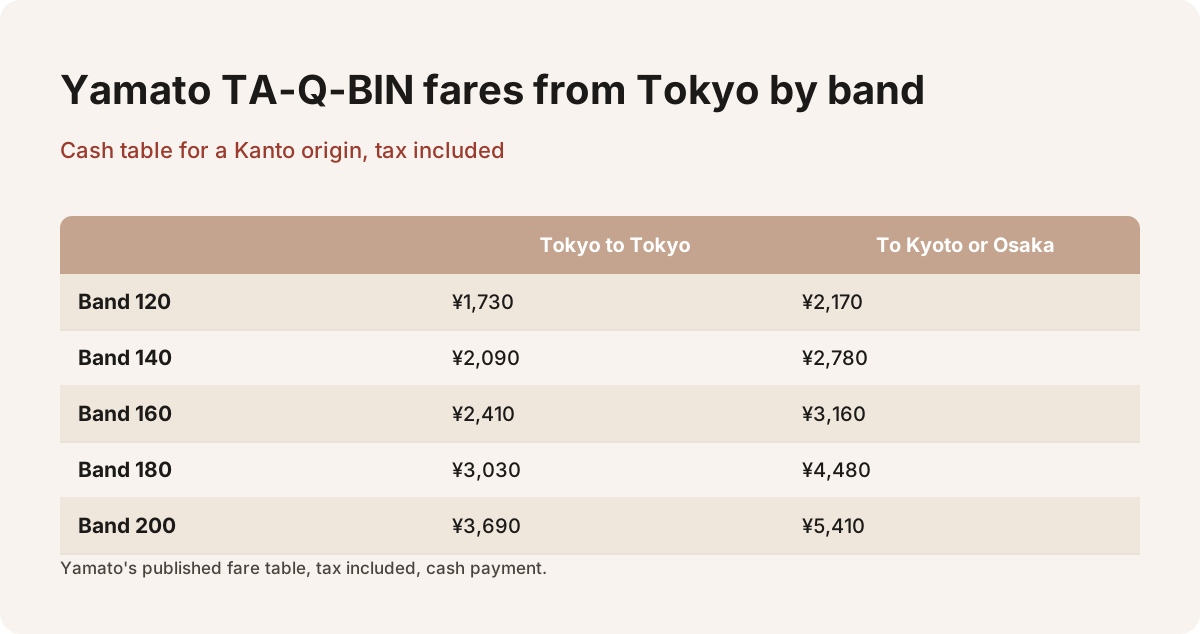
Yamato's TA-Q-BIN charges by the greater of a bag's three-side total or its weight, in eight bands from 60 (up to 60 cm or 2 kg) to 200 (up to 200 cm or 30 kg). A 140-band suitcase costs ¥2,090 within Tokyo and ¥2,780 to Kyoto or Osaka, tax included, cash payment.
The bands are simple once you see them laid out. Measure the case, add the three sides, and read down the left column. Most checked suitcases land in the 120 to 160 bands, which is also where the weight ceiling starts to bind: a heavy 140 cm case that weighs 21 kg is already a 160-band parcel on weight alone.
| Yamato band | Three-side total | Weight cap |
|---|---|---|
| 60 | up to 60 cm | up to 2 kg |
| 80 | up to 80 cm | up to 5 kg |
| 100 | up to 100 cm | up to 10 kg |
| 120 | up to 120 cm | up to 15 kg |
| 140 | up to 140 cm | up to 20 kg |
| 160 | up to 160 cm | up to 25 kg |
| 180 | up to 180 cm | up to 30 kg |
| 200 | up to 200 cm | up to 30 kg |
Hard limits sit above the top band: 200 cm total, 30 kg, and no single side longer than 170 cm. Anything bigger needs a different carrier, which is the subject of the next section. The fares below are Yamato's published cash table for a Kanto origin, tax included, and Kyoto and Osaka sit in the same tariff zone so the price is identical for both cities.
| Band | Tokyo to Tokyo | Tokyo to Kyoto or Osaka |
|---|---|---|
| 120 | ¥1,730 | ¥2,170 |
| 140 | ¥2,090 | ¥2,780 |
| 160 | ¥2,410 | ¥3,160 |
| 180 | ¥3,030 | ¥4,480 |
| 200 | ¥3,690 | ¥5,410 |
These are the operator's own figures from Yamato's published fare table, not estimates. Four discounts sit around the headline price. Carrying the parcel to a branch, convenience store or agency yourself takes ¥100 off. A Kuroneko Member waybill at a branch takes ¥150 off, though it does not stack with the ¥100. A digital waybill takes ¥60 off. Sending two or more parcels to one address takes ¥100 off each, which matters when a family posts two cases to the same hotel.
One caution before the arithmetic takes over: forwarding is not always the right tool. A bag that only needs to sit for an afternoon while its owner walks a district does not need a parcel network at all, and posting it would cost more than parking it. The comparison between the two, with real numbers on both sides, comes later in this guide. For now it is enough to know the crossover point exists and that a same-city shipment stops looking cheap the moment the stay is short.
For a traveller who wants both options in view, the 3-card selection below shows staffed storage points in three Tokyo districts that pair well with a forwarding plan, one for a night out, one for a temple district, one for a shopping street.
Which Carrier Should You Use For A Large Suitcase?
Yamato caps a takkyubin parcel at 200 cm three-side total, 30 kg and a single side of 170 cm. Sagawa's large-size service runs to 260 cm and 50 kg, with no 120 band. Japan Post's Yu-Pack stops at 170 cm and 25 kg. Only Sagawa will take a genuinely heavy or oversized case.
The three networks overlap on ordinary bags and diverge exactly where a traveller with a big checked suitcase needs them. Yamato is the densest network and the default at most hotel desks. Sagawa is the only one of the three that will carry an oversized or heavy case, and its large-size tariff, published on Sagawa's own fare table page, is the one to read before assuming a 200 cm-plus sports bag or a 40 kg case can move at all.
| Carrier | Service | Max size | Max weight | Kanto to Kansai example |
|---|---|---|---|---|
| Yamato | TA-Q-BIN | 200 cm total, one side up to 170 cm | 30 kg | 160 band ¥3,160 |
| Sagawa | Large-size | 260 cm total | 50 kg | 160 band (30 kg) ¥2,570; no 120 band |
| Japan Post | Yu-Pack | 170 cm total | 25 kg | 160 band ¥2,450 to ¥2,610 |
Two asymmetries are worth a second look. Sagawa's 160-band price to Kansai undercuts Yamato's, but Sagawa has no 120 band, so a small case can end up dearer with Sagawa than with Yamato depending on where it measures. Japan Post is the narrowest of the three and is the wrong answer for almost any wheeled suitcase, but it is the only carrier whose counter is inside every Lawson store, which sometimes matters more than the price.
Carrier choice also decides what happens at the far end. All three deliver to an address, not a locker, so somebody has to receive the parcel. That constraint shapes the Airbnb question later in this guide. Between Japanese hotels it is close to frictionless: the front desk signs for the case and holds it until check-in, and a bag sent from a Kyoto hotel on checkout morning arrives when it arrives: no public delivery-day table exists for personal parcels, though no carrier publishes a delivery day for a personal parcel on any lane.
Within a single city the calculus changes shape. A bag that only needs to cross Tokyo once, from a morning arrival to an evening hotel, can simply be parked near wherever the day is spent. In Roppongi, for instance, three staffed Radical Storage points hold bags, the nearest 199 m from the station, rated 4.88 across 47 reviews. Every point on this site is a Radical Storage partner location, named openly so a reader knows whose terms and whose guarantee stand behind the handover, and the rate is 850 yen per bag per day for a regular bag plus a 355 yen fee charged once at checkout.
The honest summary of the two tools: carriers move a bag between cities and to a fixed address; storage points hold it where the day actually happens. A traveller doing both, forwarding the big case to Osaka and keeping a daypack mobile, is using each service for what it does well, and the full breakdown sits in the forwarding versus storage in Tokyo guide.
Can You Send Luggage Between The Airport And Your Hotel?
Yes. Same-day airport-to-hotel delivery is published with real cut-offs: Sagawa collects at Narita by 14:00 and Haneda by 13:00 for delivery from 16:00, at ¥2,120 to ¥4,690 from Narita and ¥910 to ¥2,440 from Haneda. Yamato's Haneda hotel delivery cuts off at 11:00, from ¥2,450.
This is where takkyubin is at its most useful for a visitor. Land at Narita in the morning, hand the suitcase to a counter in the terminal, and ride the train into Tokyo with only a daypack. The published price bands and cut-off times below are the operators' own, and the delivery windows shown are the ones the operators print. Other pages covering the same trip are gathered on Luggage Storage in Tokyo.
| Route and operator | Price | Cut-off | Delivery window |
|---|---|---|---|
| Sagawa, Narita to Tokyo hotels | ¥2,120 to ¥4,690 by size | 14:00 | from 16:00 |
| Sagawa, Haneda to Tokyo hotels | ¥910 to ¥2,440 by size | 13:00 | from 16:00 |
| Yamato, Haneda to 23-ward hotels | ¥2,450 to ¥7,550 by size | 11:00 | from 18:00 |
| Yamato, Narita same-day | standard TA-Q-BIN rates | 10:30, or 09:50 at Terminal 3 | 18:00 to 21:00 |
| JAL ABC, airport to partner hotels | ¥1,800 per piece, up to 20 kg, cash only | apply by 13:00 | collect 16:00 to 20:00 |
| LUGGAGE EXPRESS, Tokyo hotel to Haneda or Narita | ¥4,400 to Haneda, ¥5,500 to Narita | apply by 10:00 hotel to airport | same day, by Shinkansen |
The served areas are narrower than the price lines suggest. Sagawa's airport service covers ten Tokyo wards plus Urayasu, hotels only. Yamato's Haneda service reaches the 23 wards and beyond, but to an address where somebody can receive the parcel. JAL's same-day service is hotels only, capped at 180 cm and 30 kg, and its partner-hotel list has shrunk: the whole Odaiba and Ariake cluster was suspended from it in August 2024. JAL ABC's Haneda Terminal 2 and Terminal 3 delivery counters are suspended too, Terminal 1 only.
Two asymmetries save real planning time. Yamato does not offer same-day delivery from the city to Narita at all; Sagawa does, with an 11:00 cut-off at its Tokyo counters for both airports. And the Airbnb question has only one published answer among the carriers: Yamato states that it will not deliver to minpaku, Airbnb or any unstaffed lodging unless somebody is certainly there to receive the parcel, and no convenience store accepts parcels for this product. If the booking is an apartment with a keypad and no staff, airport delivery in either direction needs a real receiving address or it does not happen.
There is also a middle case the airport tables miss: a traveller who lands early, cannot check in until the afternoon, and wants the day in the city without the bag at all. Forwarding handles that only if the hotel will receive the case, which most will. When the hotel is the problem, a storage point near the day's plans does the same job: the bag sits staffed, the traveller walks free, and the case is collected on the way to the hotel. In Roppongi the nearest such point is 199 m from the station, open for a day rate of 850 yen plus the 355 yen once-per-booking fee, so one bag for one day comes to 850 + 355 = 1,205 yen, arithmetic on Radical Storage's own published figures.
The full airport walkthroughs, train choices and counter locations, are separate guides: getting from Narita to Tokyo with luggage covers the Keisei and JR options, and the Haneda equivalent covers the monorail and Keikyu lines.
When Is Forwarding Better Than Storing A Bag In Tokyo?
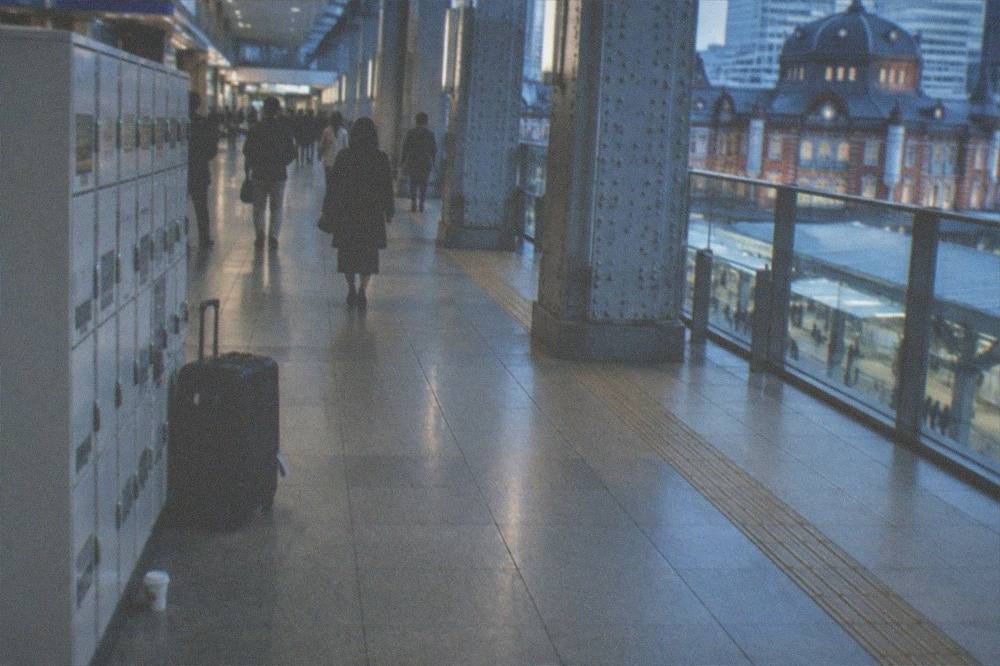
Forwarding wins when a bag would otherwise break a locker's time limit or ride the Shinkansen as oversized baggage: Tokyo Metro lockers allow 4 days including the start day, JR East Multi Ecube lockers 3, and a suitcase over 160 cm needs a free reserved seat or a ¥1,000 carry-on fee on the Tokaido Shinkansen.
The locker time limit is the quiet killer. Metro's own terms cap locker use at 4 days including the day the rental starts, and JR East Smart Logistics caps its Multi Ecube lockers at 3. Paying more does not extend either period, JR East's terms say so in as many words, and after expiry the operator opens the locker, moves the contents to separate storage where the same daily rate keeps running, and expects the traveller to collect it in person with the receipt, photo ID and the same IC card used to pay, with the separate fee payable in cash only. A bag left five days in a locker is no longer a stored bag, it is a retrieval project.
The Shinkansen rule is the other trigger, and it is narrower than most coverage implies. A three-side total over 160 cm requires a reserved oversized-baggage seat on the Tokaido, Sanyo, Kyushu and Nishi-Kyushu lines, the reservation itself is free and the seat costs the same as an ordinary reserved seat, and boarding without it risks a ¥1,000 carry-on fee. JR East's Shinkansen lines out of Tokyo, Tohoku, Hokuriku, Joetsu and the rest, have no reservation and no fee, but also no guaranteed space, storage areas exist only on some trains and cannot be reserved. The details, including the 250 cm absolute limit, are in the oversized baggage rules on the Shinkansen guide and on JR Central's official oversized baggage page.
Set against those constraints, the arithmetic is not subtle. A 160-band case posted from a Tokyo hotel to a Kyoto hotel costs ¥3,160. Storing that same bag at a Radical Storage point runs 850 yen per bag per day plus the 355 yen once-per-booking fee, so even at the Kyoto end three days of storage already costs more than the shipment before the day rates have finished adding up, and the bag still has to be carried onto the bullet train. For any trip where the suitcase is not needed until the next city, forwarding is the cheaper and lighter option, and that comparison is worked through properly in the Tokyo to Kyoto shipping guide.
For a single day inside Tokyo the answer flips. Storage at 850 + 355 = 1,205 yen for one bag for one day is far below any same-prefecture parcel rate, ¥1,730 at the cheapest 120 band, and the bag stays reachable if plans change. This is also where the storage network's depth shows: in Asakusa, thirteen staffed Radical Storage points hold bags, the nearest 193 m from the station, rated 4.85 across 268 reviews, which is the largest reviewed pool of any district on this site.
The honest crossover rule: forward between cities, park within one. A five-night Tokyo stay where the big case sits in the hotel room needs neither, a day trip from a hotel needs a storage point near the destination, and a multi-city rail itinerary is exactly what takkyubin was built for. What happens when the big case must ride the train anyway is covered in what happens if your luggage is too big for the bullet train.
What Can Go Wrong With A Takkyubin Shipment?
Yamato's liability is capped at ¥300,000 per parcel, and the ceiling is the declared value written on the waybill, not an automatic payout. Transit times are not published for personal customers on any lane, so no honest source can promise a delivery day. Packing, size and weight rules are enforced at the counter.
The liability figure is the one travellers most often get wrong. The ¥300,000 is the maximum of the declared-value field on the waybill, and Yamato pays the parcel's value within the declared amount, not a fixed sum. A waybill left blank does not buy extra cover, and any single package worth more than ¥300,000 is refused outright. The mechanism matters as much as the number: this is carrier liability under the terms of carriage, not a traveller insurance product, and it is the reason documents, medication and electronics belong in the bag that stays with you.
The transit-time gap deserves plain speech. Yamato publishes delivery times only through an interactive postcode tool and a business FAQ confirms no public service-level table exists for personal customers. Every claim of a specific day count for a city-to-city lane, in any guide, on any site, is an invention. Plan around the handover day and the arrival address instead, both of which are fully within the traveller's control.
Practical failure points are mundane and avoidable. Convenience stores may decline parcels at 180 band and above, the official caveat is store-specific rather than a network rule. Agency shops stop at the 200 band and 30 kg. Cool TA-Q-BIN, time-service and return-leg parcels cannot go through a convenience store at all. A waybill address written in roman letters is fine, but a Japanese-speaking front desk writing the waybill removes the misdelivery risk entirely, and the phrase sheet for asking a hotel to store or send luggage covers that exact conversation.
There is also a premium lane for travellers who want certainty and will pay for it. LUGGAGE EXPRESS, a JTB and JR Central service, moves bags by Shinkansen, hotel to hotel, same day, card payment only, capped at 200 cm and 30 kg: ¥13,200 Tokyo to Kyoto or Osaka, ¥4,400 Tokyo hotel to Haneda, ¥5,500 to Narita. Against a ¥3,160 truck parcel that is a steep premium, and it buys speed and a named courier rather than a lower price.
For everything in between, the storage side of the comparison is a flat 850 yen day rate plus the one-time 355 yen fee at every Radical Storage point in this guide, and the Radical Storage guarantee is capped at EUR 3,000 per claim and is not insurance, its own terms say both. A shopping day is the classic case for parking rather than posting: in Ginza, one staffed point holds bags, 1,131 m from the station, rated 4.84 across 118 reviews, and purchases can join the suitcase for the walk back.
How Do You Hand Over A Suitcase On Your Last Morning?
On a departure morning, hand the bag to the hotel front desk or a carrier branch. Sagawa's city-to-airport counters close at 11:00 for both Haneda and Narita. Sending a parcel to an airport adds ¥660 on Yamato's TA-Q-BIN, and carrying the bag to a branch yourself saves ¥100.
The last-day sequence rewards a little of yesterday evening's work. Write the destination address, or ask the front desk to, the night before. Confirm the hotel's own handover time, desks that courier daily usually send bags out by mid-morning, and note that airport-bound parcels cost ¥660 more than city-bound ones on Yamato's service. The surcharge applies to the destination, not the bag, so a family posting two cases to the same airport pays it twice but saves ¥100 per case on the multiple-parcel discount.
A morning flight changes the answer completely. A bag handed over at 11:00 is not flying anywhere useful, so an early departure means either travelling with the case, using the airport's own lockers, Haneda Terminal 1 and 2 lockers cost ¥400 to ¥1,500 per day and allow 7 days, or planning the storage side the evening before. The last day in Tokyo before a night flight guide works through that exact scenario, including where a bag can sit through a final afternoon of sightseeing.
The same logic applies in reverse at the start of a trip. A traveller arriving at Haneda with an afternoon in the city before a hotel check-in can forward the case from the airport counter by 13:00 and be free of it, or park it near the day's route and carry it to the hotel in the evening. Both are honest answers, and the choice is mostly about whether the hotel will receive the parcel, which a quick message to the property settles in advance.
That is the whole system in one view: measure the case, pick the band, hand it to a counter or a desk, and let the network carry it. When the plan is shorter than a parcel lane, the three districts below hold bags by the day at staffed points, the same three that pair with the forwarding options described through this guide.
Common Questions About Takkyubin
How much does takkyubin cost in Japan?
Yamato charges by the greater of the bag's three-side total or its weight, in bands from 60 to 200. Within Tokyo a 140-band suitcase is ¥2,090; to Kyoto or Osaka the same case is ¥2,780, tax included, with small discounts for branch drop-off, digital waybills and multiple parcels.
Can I send a suitcase from the airport to my hotel?
Yes. Sagawa collects at Narita by 14:00 and Haneda by 13:00 for delivery from 16:00, at ¥2,120 to ¥4,690 from Narita and ¥910 to ¥2,440 from Haneda, covering ten Tokyo wards plus Urayasu, hotels only. Yamato's Haneda service cuts off at 11:00 and delivers from 18:00.
Can I takkyubin luggage to an Airbnb?
Not reliably. Yamato, the only carrier with a published rule, will not deliver to minpaku, Airbnb or unstaffed lodging unless somebody is certainly present to receive the parcel, and convenience stores cannot receive these parcels. JAL's services are hotels only. A staffed hotel or a real receiving address is required.
Is my luggage covered if the carrier loses it?
Yamato's liability is capped at ¥300,000 per parcel, and the ceiling is the declared value on the waybill, so a blank field buys no extra cover and a parcel worth more than ¥300,000 is refused. This is carrier liability under the terms of carriage, not an insurance product, which is why valuables travel in the bag you keep.
Which is cheaper, takkyubin or a coin locker?
For one day a locker is cheaper: Tokyo Metro lockers run ¥300 to ¥1,000 depending on tier, at the same prices at every Metro station. Storage points cost 850 yen per bag per day plus a 355 yen fee charged once, so one bag one day is 850 + 355 = 1,205 yen. Beyond two or three days, or between cities, forwarding usually wins: a Tokyo-to-Tokyo 160-band parcel is ¥2,410, while three days of storage runs 850 yen a day plus the single 355 yen fee.
How long does takkyubin take between cities?
No carrier publishes a delivery day for personal parcels on any city-to-city lane, and any guide that names one is guessing. Hotels generally hold arriving parcels, so the practical plan is to hand the bag over on departure morning and confirm the receiving hotel can sign for it.