Haneda To Tokyo With A Suitcase: Monorail, Lockers And Delivery
Haneda is the closest of Tokyo's two airports to the city, but a checked suitcase changes the arithmetic. Here is what the monorail, the terminal storage counters, the coin lockers and the delivery services actually cost and allow, from the operators' own published pages.
Short answer
The Tokyo Monorail from Haneda to Hamamatsucho takes about 20 minutes and has dedicated luggage racks; Keikyu trains to Shinagawa also take large bags. Attended storage at Haneda costs 800 to 2,000 yen per day by size, Terminal 3 desks are open 24 hours, and same-day hotel delivery from Sagawa costs 910 to 2,440 yen if you drop the bag by 13:00.
How Do You Get From Haneda To Central Tokyo With A Suitcase?
The Tokyo Monorail runs from all three Haneda terminals to Hamamatsucho in about 20 minutes, and its trains carry dedicated luggage racks near the doors, so a full-size suitcase travels without a reservation or an extra fee. Keikyu trains from the same terminals reach Shinagawa in a similar time and simply take the bag on board like any other luggage. Neither line has an oversized-baggage rule, a surcharge or a reservation system. That is the short answer, and for most travellers arriving at Haneda with one or two suitcases it is the whole answer: pick the line that serves your side of the city, Hamamatsucho for the north and east, Shinagawa for the south and west, and roll the bag on.
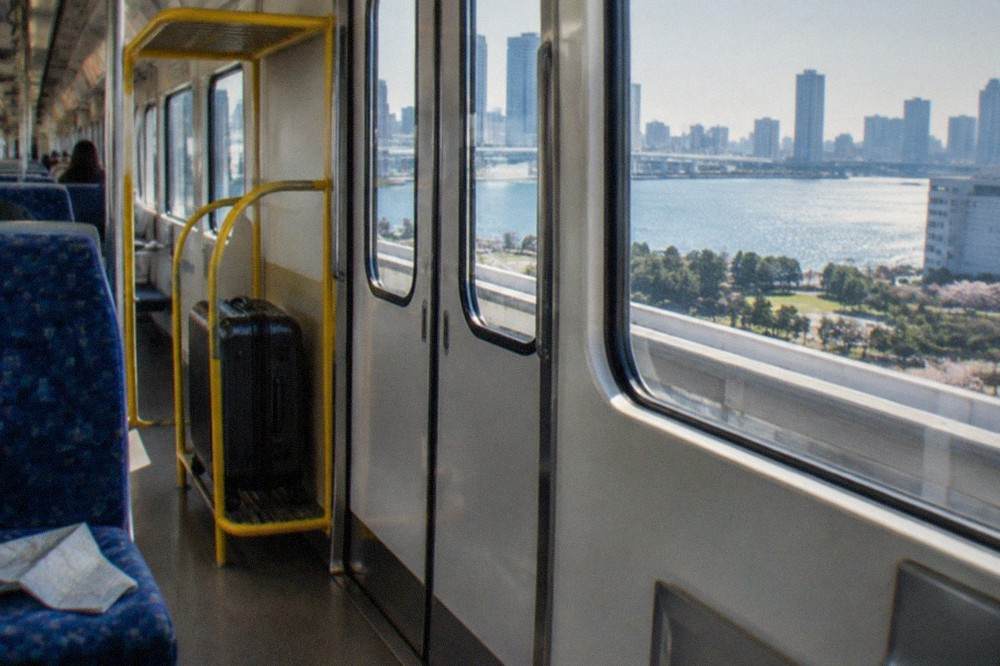
The monorail matters more for luggage than most airport guides admit. The trains were rebuilt with airport traffic in mind, and the racks beside the doors are sized for checked suitcases rather than for a backpack wedged between knees. In the rush hours the racks fill, but a monorail ride is short and the floors are level with the platform at every station, so a bag that does not fit on a rack is not a crisis the way it can be on a commuter line. Keikyu's airport trains are ordinary through-services, and the rule there is the standard one that applies to trains across the city: a bag you can lift and that blocks nobody's path travels free.
Two practical points decide the choice. Hamamatsucho connects to the JR Yamanote line and the Asakusa subway line; Shinagawa connects to the Yamanote line, the Keikyu network and the Shinkansen. If the final destination is a hotel near Tokyo Station, either works and the monorail's racks make it the easier ride with a heavy case. If the hotel is in the southern half of the city, Shinagawa saves a transfer. The question of whether the city's subway network itself suits a big bag has its own answer, covered in full in the guide to suitcases on the Tokyo Metro, including where the gates are too narrow.
Can You Store A Suitcase At Haneda Before Going Into The City?
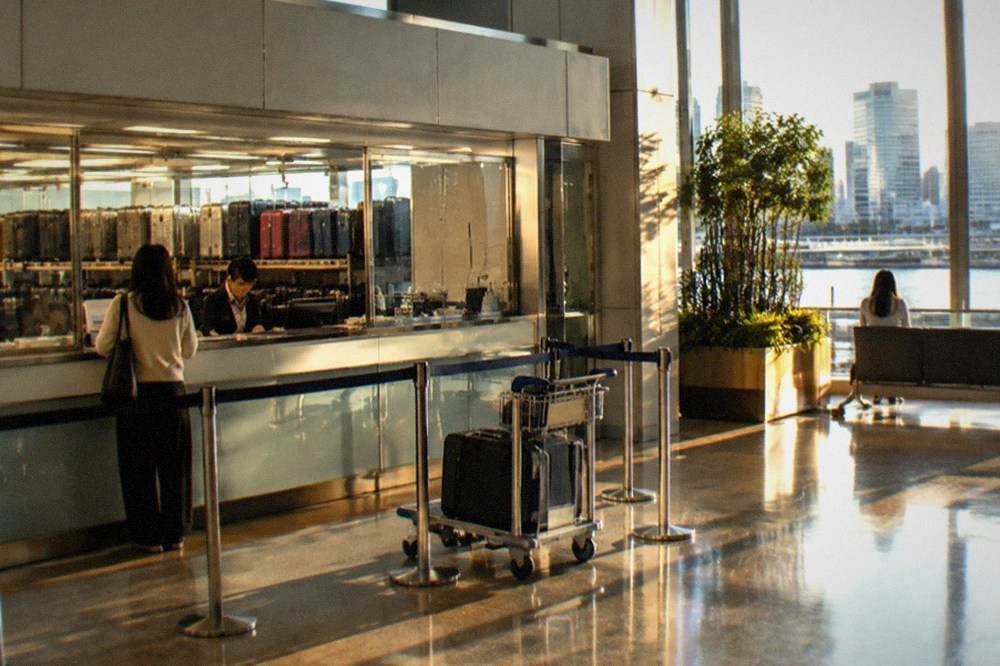
Yes, and the airport publishes the prices. Terminal 1 and Terminal 2 each have an attended desk open 08:00 to 19:30 charging 800, 1,000 or 2,000 yen per day by size, while Terminal 3 has two attended desks open 24 hours, priced per 24 hours on the same three tiers. Sagawa has counters at Terminal 1 and Terminal 2 only, at 800 to 2,000 yen per piece per day. Storage is a real option on arrival, not an afterthought: a traveller landing at 09:00 with a hotel check-in at 15:00 can drop the bag landside of the arrivals lobby and take the monorail into the city empty-handed.
| Facility | Terminal | Location | Hours | Price per day |
|---|---|---|---|---|
| Attended desk | T1 | B1F Terminal Lobby (South) | 08:00 to 19:30 | S under 120 cm ¥800 / M 120 to under 200 cm ¥1,000 / L 200 to 300 cm ¥2,000 |
| Attended desk | T2 | B1F Terminal Lobby (North) | 08:00 to 19:30 | Same three tiers |
| Attended desk | T3 | 2F Arrival Lobby | 24 hours | ¥800 / ¥1,000 / ¥2,000, per 24h |
| Attended desk | T3 | 3F Departure Lobby | 24 hours | Same tiers, per 24h |
| Sagawa Express | T1 1F Arrival (North) and T2 1F | 07:00 to 20:00 | ¥800 (≤100 cm) / ¥1,000 (≤160 cm) / ¥2,000 (161 cm+) per piece |
The airport's own sitewide rule, published on the facilities page, sets the outer limits: baggage can be stored for up to two weeks, the maximum combined length of the three sides is 300 cm, and the maximum weight is 30 kg. The full tariff and the terminal-by-terminal detail are on the airport operator's own Haneda baggage checkroom page, which is the source for the table above. One detail English coverage routinely misses: Terminal 1 and Terminal 2 price a day as a calendar day, while Terminal 3 prices the same three numbers per 24 hours. Store a bag at T3 at 22:00 and the first charge covers you to 22:00 the next night; do the same at T1 and the day ends at 19:30 when the desk closes.
Sagawa lists no counter at Terminal 3, so a T3 arrival uses the airport's own attended desks or the delivery counter on 1F. Yamato Transport runs exactly one attended storage point in the whole airport system, the international baggage counter on Terminal 2 3F: 800 yen for bags up to 140 cm, 1,000 yen up to 160 cm, 2,000 yen up to 200 cm, with handover to 22:45 and, in Yamato's own words, no limit on the storage period. That last claim sits awkwardly beside the airport's two-week rule; both are published, neither has been resolved, and a reader planning to leave a bag for a month should ask at the counter which policy applies.
A short word about the storage network this site partners with, because a reader landing at Haneda will see it advertised. Radical Storage has no storage point inside any Haneda terminal. The nearest is about 3.4 km from the airport, in Kawasaki, Kanagawa, across a prefecture boundary: useful for the monorail or Keikyu ride out of the airport, not for dropping a bag at arrivals. Four points sit near the airport on the network's map, all of them automated lockers, and the network's area page lists open 24 hours for them; none of the four has a rating yet. Where the airport's own desks win is custody and simplicity: staffed, in-terminal, with a published three-tier price.
How Does Haneda Storage Compare With A City Storage Point?
A Haneda attended desk charges 800 to 2,000 yen per day by bag size with no booking. A Radical Storage point in the city charges 850 yen per bag per day plus a 355 yen once-per-bag checkout fee, so one regular bag for one day is 850 plus 355, or 1,205 yen in total, reservable online. The airport desk is cheaper for a large bag and dearer for a small one, and the two products answer different questions: the desk covers the hours around a flight, the city point covers a day of sightseeing or a hotel-check-in gap.
The commission relationship is worth stating plainly, as this site does on every page. Radical Storage is the network; its partner shops and locker sites hold the bags; this guide neither owns nor operates any storage point and holds no bags itself. The Radical Storage Guarantee is not insurance, its own terms say so in clause 9.2.2 and allow withdrawal at any time, and payouts are capped at EUR 3,000 per claim. A coin locker's contractual liability cap, by comparison, is 30,000 yen at every major operator, and the locker terms forbid storing anything worth that much or more in the first place.
For a traveller whose first stop is the shopping district, the Ginza page of the network lists 1 point, rated 4.84 across 118 reviews, with the nearest point about 1,131 m from the centre. That is a realistic pattern for a Haneda morning: monorail to Hamamatsucho, one short subway hop, drop the bag, and the afternoon is hands-free. If the question instead is where to park a bag for a few hours rather than a full day, the same arithmetic applies everywhere in the city, and the guide to storing luggage for a few hours in Tokyo covers the short-stay options, including the fact that a few hours is billed as a full day at staffed points.
The Kawasaki point near the airport is the one place where the network's booking model earns its keep on a Haneda trip. It is reservable before the flight leaves home, it can be cancelled without charge if the plan changes mid-air, and it sits on the Keikyu line between the airport and the city, so a traveller with a long layover can drop the bag on the way into town rather than hauling it back to a terminal desk. For anyone whose itinerary is still loose, that flexibility is worth more than the 355 yen booking fee.
Reserving works the same way at every point on the network: pick the location, pay the day rate plus the once-per-bag fee, and show the confirmation at the shop. The Haneda-area point follows the same pattern, and the airport's own desks, which need no booking at all, remain the fallback for a traveller who lands without a plan.
What Do Haneda's Coin Lockers Cost, And How Long Can They Hold A Bag?
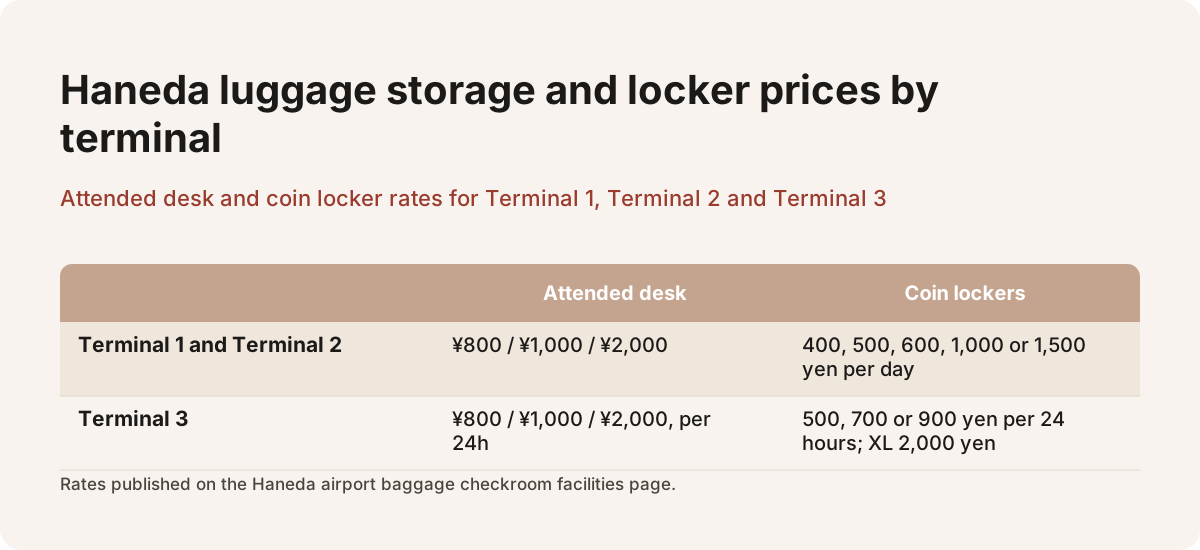
Terminal 1 and Terminal 2 lockers cost 400, 500, 600, 1,000 or 1,500 yen per day depending on size, with a 7-day maximum before the bag is moved to a separate 30-day storage. Terminal 3 lockers cost 500, 700 or 900 yen per 24 hours, with an XL tier at 2,000 yen per 24 hours in the 3F south bank, and the T3 rows list no card payment. The lockers are the cheap option for a single day and a carry-on-sized bag, and the published prices come from the airport's own locker facilities page.
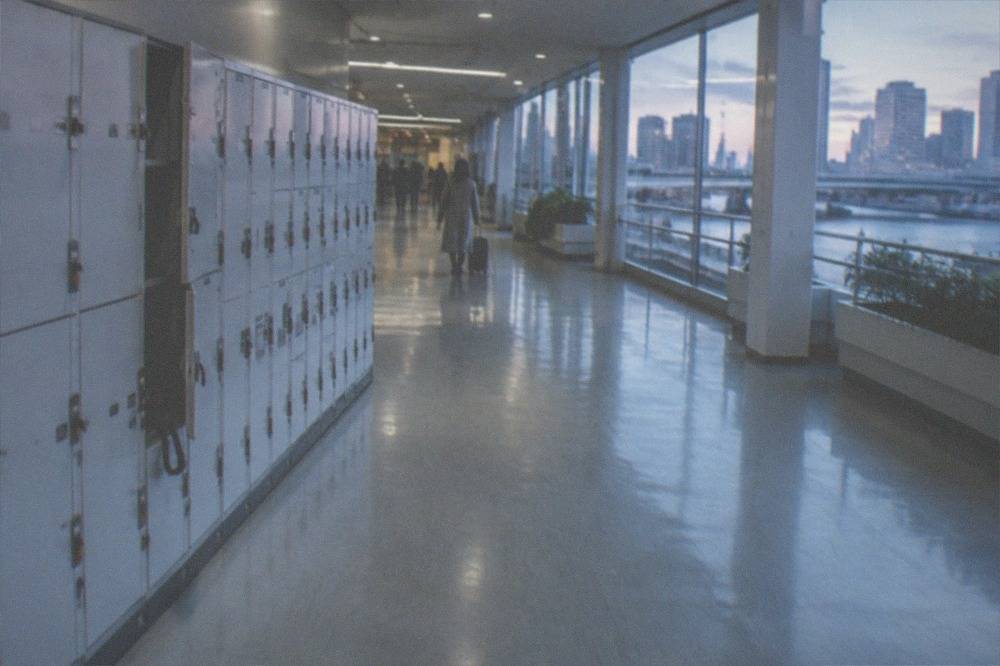
The 7-day rule at Haneda is more generous than the one inside the city's rail network. Tokyo Metro's lockers allow 4 days including the start day, and JR East's Multi Ecube units allow 3 days with no extension for extra payment, a difference that catches travellers out and is covered in detail in the guide to how long you can leave luggage in Tokyo. Haneda's own overflow rule mirrors the city operators' in one respect: after the maximum period the operator opens the locker, moves the contents to a designated place, keeps charging the daily rate, and holds the bag for 30 days from the original start date before disposal.
The practical read is a size question. A large checked suitcase at roughly 160 cm three-side total fits the 1,500 yen tier at T1 and T2 or the 2,000 yen XL tier at T3 south. A carry-on fits the 600 or 900 yen rows. Two facts decide it: T3 lockers are dearer than T1 and T2 lockers at every tier, and the T3 rows list cash and IC payment only, no card, so a traveller with no yen notes should use an ATM before the locker, or use an attended desk instead.
Can Haneda Deliver Your Suitcase To Your Hotel The Same Day?
Yes, with a hard cut-off. Sagawa Express delivers from Haneda to hotels in ten Tokyo wards plus Urayasu for 910 to 2,440 yen by bag size if the bag is handed over by 13:00, with delivery from 16:00. Yamato delivers to the 23 wards and beyond for 2,450 to 7,550 yen, cut-off 11:00, delivery from 18:00. Both prices are per bag, published by the operators themselves, and both beat the arithmetic of dragging a large case onto a rush-hour monorail.
| Operator | Price to a city hotel | Cut-off at Haneda | Delivery window | Served area |
|---|---|---|---|---|
| Sagawa Express | ¥910 (≤60 cm) / ¥1,220 / ¥1,520 / ¥2,180 (suitcase ≤140 cm) / ¥2,440 (≤200 cm) | 13:00 | from 16:00 | 10 Tokyo wards plus Urayasu, hotels |
| Yamato TA-Q-BIN | ¥2,450 to ¥7,550 to a 23-ward hotel; ¥2,600 to ¥8,330 elsewhere | 11:00 | from 18:00 | 23 wards and beyond |
| JAL Baggage Service | ¥1,500 per item delivered same day | 13:00 for bags up to 15 kg | collect 16:00 to 20:00 | Urayasu, Odaiba and Maihama areas only |
The fine print decides which of these is real. Sagawa and Yamato deliver to hotels where someone can receive the bag, and Yamato's published rule is explicit that unstaffed lodging such as an Airbnb is served only if someone is certainly present, with no convenience-store drop-off for this product. JAL's counter service is cheaper but its area is narrow, covering the Urayasu, Odaiba and Maihama hotel zones rather than the whole city. A reader weighing delivery against storage for the whole trip rather than one afternoon should read the fuller comparison in luggage forwarding versus storage in Tokyo, which works through the multi-day arithmetic.
One asymmetry worth knowing even at Haneda, because it decides the departure-day plan: Yamato will not deliver city to Narita same day, stating plainly on its own page that same-day delivery to Narita is not offered, while Sagawa will, from seven city counters by 11:00. A traveller flying home from Narita but landing at Haneda should plan the return leg on Sagawa, or plan storage, from the start. The rest of the planning pages sit on Luggage Storage in Tokyo.
Which Haneda-To-City Option Suits Which Traveller?
A traveller with a carry-on takes the monorail and rolls the bag on. A family with two large checked bags and hours before check-in uses an attended desk at 1,000 to 2,000 yen per bag per day. A case of 200 cm or more on the three-side total, or a bag nobody wants to carry, goes to Sagawa by 13:00 at 2,440 yen for a suitcase up to 200 cm. The table below matches each arrival situation to the cheapest and simplest fit, with the catch that usually decides it.
| Situation | Best fit | What it costs | The catch |
|---|---|---|---|
| Carry-on only, any destination | Monorail or Keikyu | The fare | Rush-hour crowds; racks fill |
| Checked bag, hotel near the station | Monorail with luggage rack | The fare | No catch, about 20 minutes |
| Checked bag, hours before check-in | Attended desk at any terminal | ¥800 to ¥2,000 per bag per day | T1/T2 close 19:30; T3 open 24 hours |
| Very large bag, 200 to 300 cm | Attended desk (L tier) | ¥2,000 per day | 300 cm and 30 kg are the absolute limits |
| No yen cash on arrival | Attended desk or Sagawa | From ¥800 | T3 locker rows take no card |
| Whole day hands-free in the city | Delivery to hotel | ¥910 to ¥2,440 (Sagawa), by 13:00 | Hotels and staffed lodging only |
The row that surprises people is the last one. Delivery at 2,440 yen for a 140 cm suitcase is roughly double what one day of attended storage costs, but it buys a whole afternoon without the bag rather than a few hours, and it removes the return trip to the airport entirely on a same-day-departure plan. Against a Radical Storage point, one regular bag for one day is 850 plus 355, or 1,205 yen in total: cheaper than the Haneda L tier, dearer than the S tier, and usable only in the city rather than at the terminal. There is no single winner, which is why this page prints the numbers and leaves the choice to the reader.
Storing The Bag On The Way Back To The Airport
On departure day the same desks work in reverse: an attended desk at Terminal 1, 2 or 3 holds a bag from 800 yen per day, and Terminal 3's desks are open 24 hours, so an early-morning flight or a late-night departure both work. Terminal 2 also hosts Yamato's international counter with handover to 22:45 and no published limit on the storage period. A traveller with a 22:00 flight and an 11:00 hotel checkout can hand the bag over at any terminal, spend the day in the city, and collect before security.
The trick is matching the desk's hours to the flight. Terminal 1 and Terminal 2 desks close at 19:30, which is fine for a collection before an evening flight but useless for a 21:00 departure with a bag to retrieve. Terminal 3's two desks have no closing time, which makes T3 the natural choice for late departures even from a T1 flight, since the terminals are connected airside and landside by free shuttle and walkway. The last-day plan has enough moving parts, from temple visits to a monorail ride, that this guide's companion piece on the last day in Tokyo before a night flight works through the timings in full.
For a departure from the other airport, the picture is different in one decisive way. Narita's attended counters are government-certified under the hands-free travel scheme, eleven of them across Terminal 1 and Terminal 2, with the Promotion Foundation desk the cheapest at 500 to 1,100 yen per day, but there is no attended counter in Terminal 3 at all, and the airport publishes no combined price list. The Radical Storage map shows 1 point near Narita, staffed, with a 5.0 rating from a single review, and it sits about 6.0 km from the airport in Tomisato, Chiba. The monorail question that opens this page has no Narita equivalent: the run into the city is an hour, which is why the guide to Narita to Tokyo with luggage leans harder on forwarding.
Where Does The Ginza First-Stop Plan Fit In?
A monorail arrival at Hamamatsucho puts Ginza about two short subway stops or one taxi hop away, making it the most common first stop for a Haneda morning. The district's one Radical Storage point, rated 4.84 across 118 reviews with the nearest about 1,131 m from the centre, costs 850 yen per bag per day plus the 355 yen once-per-bag checkout fee, so 1,205 yen total for one bag for one day. Store at Hamamatsucho or in Ginza itself and the afternoon from the airport to the hotel door is bag-free.
The plan works best in one direction. Landing at 09:00, the traveller has the bag, the monorail and about four hours before a typical 15:00 check-in, covered in the guide to Tokyo hotel check-in times. The two realistic shapes are: an attended desk at Haneda if the return to the airport is same-day, or a city point if the bag is needed at the hotel by evening anyway. What the plan should not rely on is a hotel that has not been asked. Whether a hotel will hold a bag for a non-guest, and how the request works in Japanese, is its own question, answered with phrasing a reader can actually use in the post on leaving luggage at a hotel you are not staying at.
Common Questions About Getting From Haneda To Tokyo With Luggage
Can you take a suitcase on the Tokyo Monorail from Haneda?
Yes. The monorail's airport trains have dedicated luggage racks beside the doors sized for checked suitcases, there is no oversized-baggage rule, no surcharge and no reservation. The ride to Hamamatsucho takes about 20 minutes and the floors are level with the platform at every station.
How much does luggage storage at Haneda Airport cost?
The airport's own desks charge 800 yen per day for a bag under 120 cm, 1,000 yen for 120 to under 200 cm, and 2,000 yen for 200 to 300 cm. Sagawa's Terminal 1 and 2 counters charge 800 to 2,000 yen per piece per day by size, and Yamato's Terminal 2 counter charges 800 to 2,000 yen.
Is Haneda Terminal 3 luggage storage open at night?
Yes. Terminal 3's attended desks on the 2F Arrival Lobby and 3F Departure Lobby are open 24 hours, priced per 24 hours rather than per calendar day, the same 800, 1,000 and 2,000 yen tiers. Terminal 1 and Terminal 2 desks close at 19:30.
Can Haneda deliver my luggage to my hotel the same day?
Yes, if you make the cut-off. Sagawa Express delivers to hotels in ten Tokyo wards plus Urayasu for 910 to 2,440 yen by bag size, handing over by 13:00 for delivery from 16:00. Yamato covers the 23 wards and beyond for 2,450 to 7,550 yen, cut-off 11:00, delivery from 18:00.
How long can you leave a bag in a Haneda coin locker?
Up to 7 days, after which the contents are moved to a separate storage place, the daily rate keeps running, and the bag is held for 30 days from the original start date before disposal. Haneda's limit is longer than Tokyo Metro's 4 days or the JR East Multi Ecube 3 days.
Is there a Radical Storage point inside Haneda Airport?
No. Radical Storage has no storage point inside any Haneda terminal. The nearest is about 3.4 km from the airport, in Kawasaki, Kanagawa. For in-terminal storage, use the airport's own attended desks or the coin lockers.