24 Hour Bag Storage In Tokyo: What Is Actually Open Overnight
The 24-hour badge is the most over-claimed feature in Tokyo luggage storage. Here is where overnight storage genuinely exists, what it costs, and where the day boundary catches people out.
Short answer
Yes. Of 249 Radical Storage points in Tokyo, 146 are not open 24 hours, so the genuine overnight points are the minority, clustered in Shibuya, Shinjuku, Ikebukuro and around Haneda. A regular bag costs 850 yen per day plus a one-off 355 yen fee, so one day is 1,205 yen. Haneda Terminal 3 runs the only attended airport counter open 24 hours.
Are There 24 Hour Luggage Storage Options In Tokyo?
Yes, but far fewer than the advertising suggests. Of the 249 Radical Storage points across Tokyo, 146 are not open 24 hours, which leaves a minority that are, clustered around Shibuya, Shinjuku, Ikebukuro and the airports. The only attended airport counter genuinely open 24 hours is at Haneda Terminal 3, where storage is priced per 24 hours at 800 to 2,000 yen.
The question sounds simple and the honest answer has three layers. The first layer is the network: Radical Storage, the partner whose Tokyo points this site catalogues, publishes area pages with "24/7" in most of their titles, and that wording is a template rather than a fact about any individual location. Across the 249 Tokyo points on file, 146 are not open 24 hours. A reader who reserves a point on the strength of a page title alone has roughly a three-in-five chance of landing somewhere with posted closing hours.
The second layer is the type of facility. A staffed drop-off point, a shop or hotel counter that takes bags, has whatever hours the shop has. An automated locker is open whenever the building around it is open. The two behave very differently at 3 a.m., and the roster data reflects that: the areas with genuine 24-hour points are the ones with either dedicated locker sites or businesses that run all night.
The third layer is the airport question, which is where most overnight storage actually happens. A traveller with a 6 a.m. departure is not wondering about Shibuya. They want to know whether a terminal holds their bag until the gate opens, and the answer differs sharply between Haneda and Narita, covered in full below. For everything else, start with the practical summary: if the plan is a late night out and a bag collected after midnight, a 24-hour point in Shibuya or Shinjuku or a Terminal 3 counter at Haneda are the realistic options.
Which Tokyo Areas Have Storage Points Open 24 Hours?
Shibuya, Shinjuku, Ikebukuro, Harajuku, Shinagawa and the area around Haneda are where the 24-hour points sit. Shibuya lists three of its seven points as open 24 hours, Haneda lists all four, and Shinjuku and Ikebukuro list two each. Asakusa, Ginza, Ueno and Akihabara, by contrast, list none, so overnight there means lockers or a hotel.
The pattern is not random. The districts with 24-hour points are the ones whose economy runs late: Shibuya's points sit in businesses that stay open past midnight, and Ikebukuro, the busiest terminal on the Seibu and Tobu side of the city, has ten points in total with two carrying the 24-hour flag. Radical Storage's Tokyo points are counted by area below, with the 24-hour ones flagged, and the "listing 24 hours" column counts individual points, not businesses or buildings.
| Area | Points | Listing 24-hour access | Rating (reviews) | Nearest point |
|---|---|---|---|---|
| Shibuya | 7 | 3 | 4.75 (163) | 306 m from the station |
| Shinjuku | 8 | 2 | 4.75 (384) | 187 m |
| Ikebukuro | 10 | 2 | 4.73 (89) | 227 m |
| Haneda Airport area | 4 | 4 | no reviews yet | 3,416 m |
| Harajuku | 4 | 1 | 4.93 (38) | 172 m |
| Shinagawa | 3 | 1 | 4.45 (12) | 1,205 m |
Read that table with two cautions. First, Haneda's four points all list 24-hour access, but none of them sits inside a terminal: the nearest is about 3.4 km away in Kawasaki, Kanagawa, across a prefecture boundary. A 24-hour badge 3.4 km from the airport is not the same product as a counter in Terminal 3, and no bag can be dropped inside a terminal through this site. Second, a point listing 24 hours and a point actually answering the door at 4 a.m. are verified the same way: on the point's own card on Radical Storage's Tokyo map before reserving.
Shibuya deserves its own note because it is the strongest 24-hour district on the board. Seven points in total, three listing 24-hour access, five automated lockers among them, and a 4.75 rating across 163 reviews, the second-largest review pool of any station area after Shinjuku. For a night out that ends when the last trains have gone, Shibuya is where the maths works.
The reverse case matters too. Asakusa, the district most first-time visitors assume will have all-night storage, lists none of its 13 points as 24 hours. Ginza's single point, rated 4.84 across 118 reviews, sits 1131 m away. The practical consequence: in those districts an overnight bag belongs in a coin locker, a hotel, or a forward shipment, and the coin locker day rules in a later section decide which.
How Much Does An Overnight Bag Cost In Tokyo?
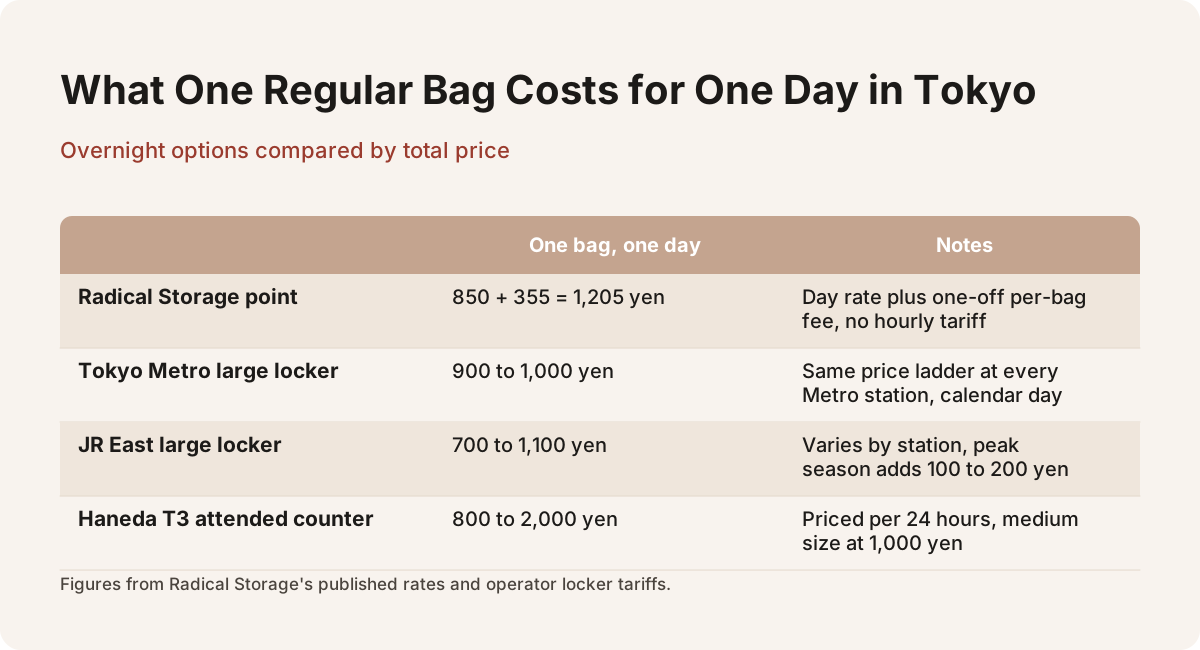
A regular bag at a Radical Storage point costs 850 yen per day plus a 355 yen per-bag fee charged once at checkout, so one bag for one day is 850 plus 355, or 1,205 yen. There is no hourly tariff: a two-hour drop is billed as a full day. The advertised 490 yen rate is a small-bag rate at 11 points only.
Overnight storage is where the fee structure matters most, because a single day is the shortest billable unit. The 850 yen day rate applies to a regular bag at 244 of the 249 Tokyo points on file. The 355 yen fee is charged once per bag at checkout and does not scale with the number of days, so a two-night stay is 850 plus 850 plus 355, presented as arithmetic on Radical Storage's own published figures rather than a quoted checkout price. Quoting the day rate alone understates a one-day booking by roughly a third.
Two traps sit inside the pricing pages. Radical Storage advertises "from 490 yen per day", and that figure is a small-bag rate found at 11 points only, never the price a traveller with a normal suitcase pays. And a card showing 750 yen is not a cheaper point: staffed points display the small-bag rate while automated lockers display the regular rate, and both carry the same 750, 850 and 1,100 tiers underneath. The like-for-like figure for a regular bag, everywhere in the city, is 850.
| Option | What one regular bag, one day costs | Notes |
|---|---|---|
| Radical Storage point | 850 + 355 = 1,205 yen | Day rate plus one-off per-bag fee, no hourly tariff |
| Tokyo Metro large locker | 900 to 1,000 yen | Same price ladder at every Metro station, calendar day |
| JR East large locker | 700 to 1,100 yen | Varies by station, peak season adds 100 to 200 yen |
| Haneda T3 attended counter | 1,000 yen (medium size) | Priced per 24 hours, not per calendar day |
Those are different products with different size limits, so the table is a planning comparison rather than a like-for-like tariff. The locker tiers, internal dimensions and duration rules are covered in the coin locker sizes guide, and the full price picture across every storage type is in Tokyo luggage storage prices.
Can You Leave A Bag Overnight At Haneda Or Narita?
Yes, though only Haneda Terminal 3 is truly open 24 hours, with two attended desks pricing 800, 1,000 or 2,000 yen per 24 hours and a two-week limit. Narita has no attended counter in Terminal 3 at all, but its coin lockers run to 8 days at 400 to 800 yen, with the day rolling at midnight.
Haneda is the stronger airport for overnight storage, and the reason is Terminal 3, the international terminal. Both of its attended desks, on the 2F arrival lobby and the 3F departure lobby, are open 24 hours, priced per 24 hours rather than per calendar day. The airport's own sitewide rule caps storage at two weeks, with a maximum combined three-side length of 300 cm and a maximum weight of 30 kg. Terminals 1 and 2 run their attended counters from 08:00 to 19:30 only, priced per calendar day at the same 800, 1,000 and 2,000 yen tiers, so an overnight drop at T1 or T2 is possible but the bag is locked behind the counter's clock, not yours. The full tariff is on the airport's own facilities page.
Narita works differently in three ways. First, all eleven attended baggage-storage counters sit in Terminals 1 and 2, run by JAL ABC, Sagawa Express and the Narita Airport Promotion Foundation; there is not one attended counter in Terminal 3, whose only baggage desk of any kind is a delivery counter. Second, the airport itself publishes no prices, so the real figures come from each operator: the Promotion Foundation desk in T2 is the cheapest at 500, 700 or 1,100 yen by size, while JAL ABC charges 800, 1,000 or 2,000 yen and bills by calendar day, not by the hour. Third, Narita's coin lockers run eight days at 400, 600 or 800 yen, with the day rolling at midnight, and an hourly tariff exists at only two locations in the whole airport, the T2 B1F bank and the T3 2F bank. The operator's own page at narita-airport.jp carries the locker detail.
| Facility | Hours | Price | Max stay |
|---|---|---|---|
| Haneda T3, 2F and 3F counters | Open 24 hours | 800 / 1,000 / 2,000 yen per 24h | 2 weeks |
| Haneda T1 and T2 counters | 08:00 to 19:30 | Same tiers, per day | 2 weeks |
| Narita Promotion Foundation, T2 | 06:30 to 22:00 | 500 / 700 / 1,100 yen | Not published by the airport |
| Narita JAL ABC, 7 counters | Varies by counter | 800 / 1,000 / 2,000 yen, calendar day | Extension charge past declared date |
| Narita coin lockers | Building hours | 400 / 600 / 800 yen per day | 8 days |
One caution specific to Radical Storage at the airports: the single point near Narita sits about 6.0 km away in Tomisato, Chiba, and it does not list 24-hour access. They are a fair option for a bag held for several days near the airport, not for a midnight terminal drop. Narita's own points carry a 5.0 rating, but from just 2 reviews, which is a rating from two people rather than a verdict.
Do Coin Lockers Count As 24 Hour Storage?
Mostly no. Tokyo Metro lockers run from first train to last train, and the day is counted with a roll at 2 a.m., so a bag left past the last train tips into a new day. JR East's Multi Ecube lockers cap storage at 3 days, and paying more does not extend the period. Overnight yes, 24 hours no.
The subway locker system is the default thing a traveller reaches for, and its hours are the trap. A Metro locker is usable from first train to last train; outside that window there is no staffed desk and no way in. The terms are explicit that a day is added at 2 a.m., and that the first and last days each count as a whole day however briefly the locker was used. Metro Commerce's own terms, at metocan.co.jp, publish the ladder, 300 to 1,000 yen, and the same prices apply at every Metro station; only the mix of door sizes varies by station.
| Operator | Max period | Day boundary |
|---|---|---|
| Tokyo Metro (Metro Commerce) | 4 days including the start day | 2 a.m. |
| JR East Multi Ecube | 3 days, paying more does not extend it | 2 a.m., reservation adds 500 yen |
| Narita airport lockers | 8 days | Midnight |
| Haneda T1 and T2 lockers | 7 days | Per day |
| Haneda T3 lockers | 7 days | Per 24 hours, dearer tiers than T1 and T2 |
Two more rules decide whether a locker can stand in for a 24-hour point. On a Multi Ecube locker, one open ends the rental: retrieve the bag and it cannot go back, and a multi-day reservation is forfeited with no refund, the only grace being a 15-minute reopen window. And the operators genuinely disagree on duration, Metro at four days, JR East Smart Logistics at three, so never assume one rule applies everywhere. The retrieval mechanics, what to keep and what to do if the ticket is lost, are in how long you can leave luggage in Tokyo, and the payment methods are broken out in the coin locker payment guide.
What About Staffed Points That Are Simply Open Late?
Akihabara has nine Radical Storage points, all staffed drop-offs, the nearest 31 metres from the station, rated 4.88 from 171 reviews, and none of them lists 24-hour access. That is the honest picture across most of Tokyo: a badge that says 24 hours is a claim on a card, and posted staffed hours are what actually govern the drop.
This matters for the traveller whose real problem is not midnight but the awkward edges of the day: a 6 a.m. Shinkansen out of Tokyo Station, or a 1 a.m. return from a night in Akihabara's arcades. A staffed point with hours from early morning to late evening solves the first and not the second. Akihabara's cluster is the densest staffed group on the roster, nine points within walking distance of the station, every one a person behind a counter rather than a machine, which is the version of storage where a human checks the bag in and hands it back.
The guarantee question follows the same honesty rule. Every point here is a Radical Storage partner location, and the protection attached to a booking is the Radical Storage Guarantee, which is not insurance: their own terms say so, and they reserve the right to withdraw it. Payouts are capped at EUR 3,000 per claim, stated in euros exactly as the terms state it. A reader handing a stranger their suitcase deserves to know whose name is on the promise.
For the early-morning case specifically, the realistic shortlist is short. A Haneda T3 counter, open 24 hours, handles an airport-side dawn. A 24-hour point in Shibuya or Shinjuku handles a night out. A staffed point with posted hours handles everything in between, checked in advance on the point's own card. And for a bag that needs to survive a whole week, the long-stay options, including station baggage rooms at Tokyo and Ueno that take bags for 30 days at 500 to 2,000 yen per day, are covered in overnight and long-term storage in Tokyo.
What Happens If You Come Back Later Than Planned?
At a Radical Storage point, a late return simply adds a day at the 850 yen rate, and the 355 yen fee does not recur. At a coin locker, expiry triggers a scripted process: the operator empties the locker, holds the contents for 30 days from the start date, keeps charging the daily rate, and takes cash only for the separate storage.
The two systems treat lateness very differently, and the difference is worth knowing before the night it happens. A staffed or automated Radical Storage point has no expiry event to trigger: days simply accrue at the published rate, and the per-bag fee was charged once at checkout. There is no part-day rate, so a bag collected an hour past the 24-hour mark has crossed into a second day, but there is no penalty layer on top of it.
A coin locker is contractual and mechanical. When the maximum period expires, the operator unlocks the locker, inspects the contents and moves them to a designated place, where they are held for 30 days counted from the start date of the original rental. The same daily rate keeps running during that separate storage, the separate storage fee is cash only, and collection needs the receipt, photo ID and the same IC card used to pay. The traveller's own travel costs to go and collect are theirs. After 30 days the contents are deemed abandoned, and JR East disposes of food immediately with no grace period at all.
The practical defences are small ones. Keep the paper retrieval ticket from a locker, because the operator's own FAQ and its terms disagree on whether the IC card is needed, and the ticket satisfies both. Note the four-digit door number. And if the plan is genuinely loose, a 30-day baggage room at Tokyo Station's Yaesu South counter, at 500 to 2,000 yen per day by size, buys far more slack than any locker, a comparison expanded in where to store luggage for a few hours and across the Tokyo storage map.
One overnight question this site gets asked in a Japanese-language fan-out deserves a direct answer here: does 24-hour storage mean the bag can be collected at any hour, or only that it can be dropped at any hour? At a Radical Storage point listing 24 hours, both directions hold, because there is no closing procedure. At a staffed point, neither direction holds outside posted hours. At an airport counter open 24 hours, both hold. The badge tells you which of the three you are standing in front of, and that is the whole reason to check it rather than trust a page title.
Planning An Overnight Drop: The Short Version
An overnight bag in Tokyo is solved in exactly four ways: a Radical Storage point listing 24-hour access, most thickly in Shibuya, Shinjuku and Ikebukuro, and just 1 point near Narita, about 6,020 m from the airport, rated 5 from 1 review; a Haneda Terminal 3 counter at 800 to 2,000 yen per 24 hours; a Narita or Haneda coin locker inside its day rules; or a station baggage room for a genuinely multi-day hold at 500 to 2,000 yen per day. Everything else is noise around those four answers.
The cost picture is equally short. A regular bag is 850 yen per day plus a 355 yen one-off fee at any Radical Storage point in the city, 1,205 yen for a single day, no hourly tariff anywhere in the network. A large subway locker is 900 to 1,000 yen for a calendar day. A Haneda T3 medium bag is 1,000 yen per 24 hours. Within a few hundred yen of each other, the choice is decided by the clock, not the price.
The area-level detail behind those four answers, the door counts, the locker dimensions and the per-district point lists, is spread across the guides on Luggage Storage in Tokyo, and each one links back to the next. The one thing no page here can do is promise that a specific point's hours have not changed since the roster was compiled, so the last check, the point's own card on Radical Storage's Tokyo map, is always the reader's.
Common Questions About 24 Hour Bag Storage
Are there 24 hour luggage storage options in Tokyo?
Yes. Of the 249 Radical Storage points across Tokyo, 146 are not open 24 hours, so the genuine overnight points are the minority, clustered in Shibuya, Shinjuku, Ikebukuro and around Haneda. The only attended airport counter open 24 hours is at Haneda Terminal 3, priced at 800 to 2,000 yen per 24 hours with a two-week limit.
Which Tokyo stations have storage open 24 hours?
Shibuya lists three of its seven points as open 24 hours, Shinjuku and Ikebukuro list two each, and Harajuku and Shinagawa list one each. All four points in the Haneda Airport area list 24-hour access, though the nearest sits about 3.4 km from the terminals in Kawasaki. Asakusa, Ginza, Ueno and Akihabara list none.
How much does overnight bag storage cost in Tokyo?
A regular bag at a Radical Storage point is 850 yen per day plus a 355 yen per-bag fee charged once at checkout, so one bag for one day is 850 plus 355, or 1,205 yen. There is no hourly tariff; a few hours is billed as a full day. The advertised 490 yen rate is a small-bag rate at 11 points only.
Can I leave my bag overnight at Haneda Airport?
Yes. Haneda Terminal 3 has two attended desks, on the 2F arrival lobby and the 3F departure lobby, both open 24 hours, charging 800, 1,000 or 2,000 yen per 24 hours by size, with a two-week maximum. Terminals 1 and 2 run their counters from 08:00 to 19:30 only, priced per calendar day.
Can I leave my bag overnight at Narita Airport?
Yes, but not in Terminal 3, which has no attended baggage-storage counter at all. Narita's eleven counters sit in Terminals 1 and 2, from 500 yen per day at the Promotion Foundation desk up to 2,000 yen at JAL ABC, which bills by calendar day. Narita's coin lockers run to 8 days at 400 to 800 yen per day, with the day rolling at midnight.
What happens if I leave my bag in a coin locker past the limit?
The operator unlocks the locker, inspects the contents and moves them to a designated place, where they are held for 30 days from the original start date. The same daily rate keeps running, the separate storage fee is cash only, and collection requires the receipt, photo ID and the IC card you paid with. After 30 days the contents are deemed abandoned, and JR East disposes of food immediately.